

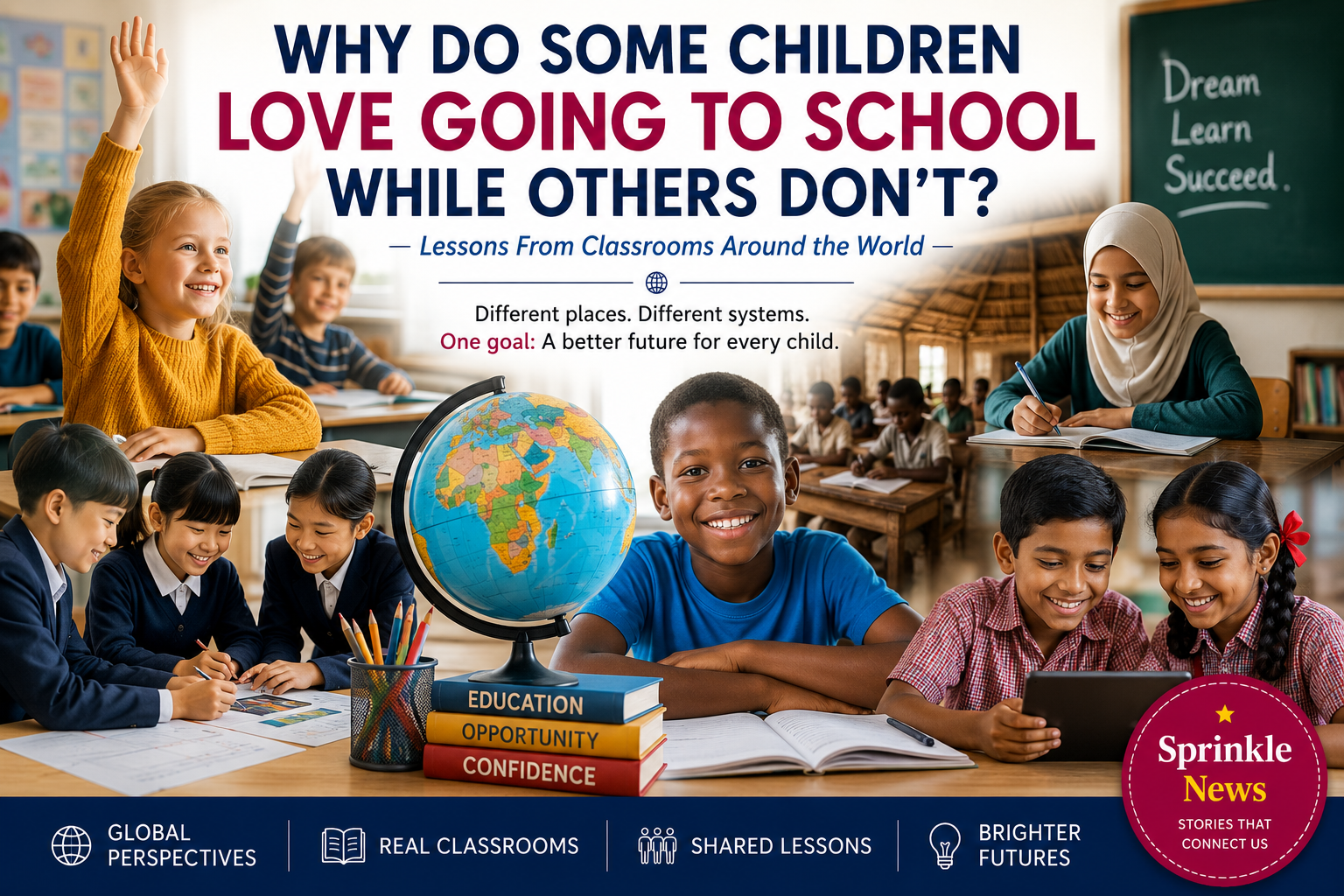

Why Do Some Children Love Going to School While Others Don’t?
Lessons From Classrooms Around the World
For millions of children around the world, the sound of the school bell brings excitement.
For others, it brings anxiety.
Some children wake up eager to learn, meet friends and discover something new.
Others struggle to find motivation, counting down the hours until the school day ends.
Why is there such a difference?
The answer is not as simple as saying one child likes school and another does not.
The reasons are often shaped by teaching methods, family support, school environments, culture and the opportunities available to students.
Around the world, educators continue searching for ways to make learning more enjoyable, meaningful and accessible.
Perhaps every country has something to teach us.
Learning Beyond Textbooks
In many schools today, education is no longer centred only on memorising facts.
Teachers increasingly encourage students to ask questions, solve problems, work together and think creatively.
Project-based learning allows children to investigate real-world challenges.
Science experiments replace some traditional lectures.
Technology opens classrooms to the wider world.
Students can now communicate with classrooms on different continents, explore museums virtually and learn from experts thousands of kilometres away.
Education is becoming less about remembering information and more about understanding how to use it.
Different Countries, Different Approaches
There is no single perfect education system.
Each country reflects its own culture, history and priorities.
In Finland, children typically begin formal schooling later than in many countries, yet they consistently achieve strong educational outcomes. Finnish schools place great emphasis on trust, well-being, highly trained teachers and balanced learning rather than excessive testing.
In Japan, students are encouraged to take responsibility for their learning environment. In many schools, pupils help clean their classrooms and dining areas, reinforcing teamwork, discipline and respect for shared spaces.
In Singapore, education has earned international recognition for its strong focus on mathematics, science and problem-solving. At the same time, reforms continue to encourage creativity, innovation and holistic development alongside academic excellence.
In the Netherlands, many schools encourage independent thinking. Students are often expected to express their opinions, work collaboratively and develop confidence in making decisions while maintaining a healthy balance between learning and personal well-being.
Meanwhile, schools in many developing countries continue to achieve remarkable results despite limited resources. Dedicated teachers, supportive families and determined students often overcome challenges that would discourage others.
These examples remind us that excellent education is not defined by one model alone.
What Makes Children Enjoy School?
Research and experience suggest that children are more likely to enjoy school when they:
- Feel safe and respected.
- Have supportive teachers.
- Build positive friendships.
- Participate in engaging lessons.
- Feel encouraged rather than constantly criticised.
- Have opportunities to explore their interests.
- Believe that learning has a purpose.
When these ingredients come together, classrooms become places of curiosity rather than obligation.
The Teacher Still Matters
Technology is transforming education faster than ever before.
Artificial intelligence can answer questions in seconds.
Students can watch online lessons from almost anywhere in the world.
Digital libraries provide access to millions of books.
Yet one factor continues to influence learning more than almost anything else.
A good teacher.
Teachers inspire confidence.
They notice potential.
They encourage persistence.
They often become the reason a child begins believing in themselves.
Long after students forget individual lessons, many remember the teacher who made them feel capable.
Parents and Communities Also Play a Role
Learning does not begin and end in the classroom.
Parents who read with their children, encourage curiosity and show interest in education often help build positive attitudes towards learning.
Communities that value education create environments where young people believe that knowledge matters.
When families, schools and communities work together, children are more likely to thrive.
Preparing Children for Tomorrow
The world is changing rapidly.
Many of today’s students will work in careers that do not yet exist.
Success will depend not only on academic knowledge but also on adaptability, communication, creativity, digital literacy and lifelong learning.
Perhaps the greatest lesson education can teach is not simply how to pass examinations, but how to continue learning throughout life.
Sprinkle News Reflection
Education is one of the few investments that benefits individuals, families, communities and entire nations.
Every classroom tells a different story.
Every teacher leaves a unique influence.
Every child learns differently.
As countries continue to improve their education systems, perhaps the greatest lesson is that learning should inspire curiosity, confidence and hope.
Because when children enjoy learning, they are not simply preparing for examinations.
They are preparing for life.
Join the Conversation
What made you enjoy school—or dislike it?
Was it a teacher, the subjects, your classmates or something else?
If you could borrow one idea from another country’s education system, what would it be?
Share your thoughts in the comments below.


