

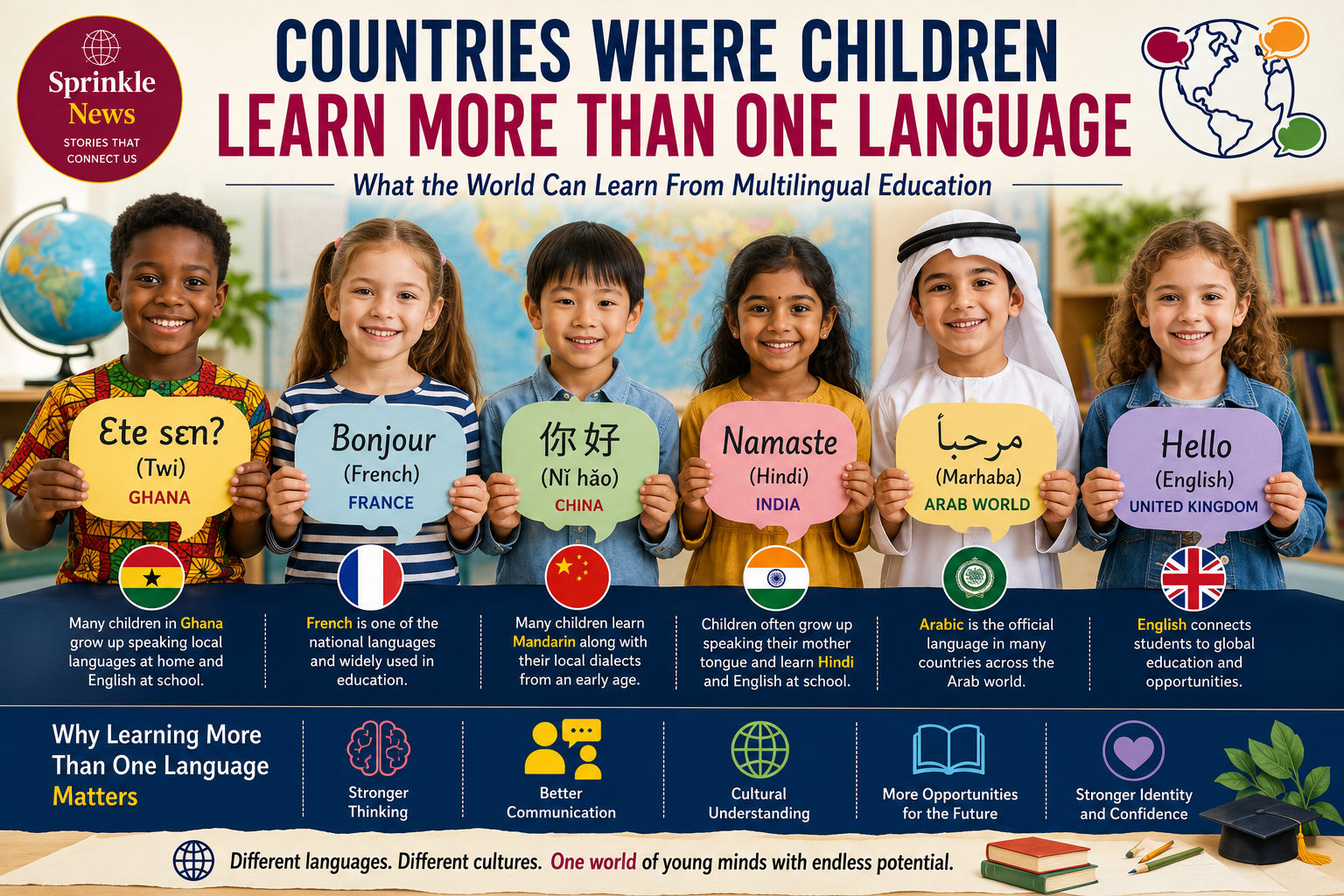
Countries Where Children Grow Up Speaking More Than One Language
What the World Can Learn From Multilingual Education
Category: Education | Global Learning | Language
In many parts of the world, children grow up hearing more than one language before they even enter a classroom.
At home, they may speak one language with their parents.
In the community, they may hear another.
At school, they may learn in an official national language.
On television, online or through music, they may be exposed to even more.
For some children, speaking more than one language is considered exceptional.
For others, it is simply everyday life.
Multilingual education is not just about learning words. It is about identity, culture, communication and opportunity. It connects children to their families and communities while also preparing them for a wider world.
Ghana: Many Languages, One Classroom Experience
Ghana is a strong example of a multilingual society.
English is the official language and is widely used in education, government, business and formal communication. But many Ghanaian children grow up speaking local languages at home and in their communities before they become fully confident in English.
Depending on where they live, children may hear or speak languages such as Akan, including Twi and Fante, Ewe, Ga, Dagbani, Nzema, Dagaare, Gonja, Kasem and many others.
This means many children naturally move between languages from a young age.
A child may speak one language at home, hear another in the neighbourhood and learn English at school. This gives children a rich linguistic background, but it can also create challenges when early education happens in a language they do not yet fully understand.
UNESCO has repeatedly argued that children learn better when they begin education in a language they understand well, especially in the early years. Mother tongue-based multilingual education can improve understanding, confidence and inclusion.
Switzerland: A Country of Several National Languages
Switzerland is one of the best-known multilingual countries in Europe.
It has four national languages: German, French, Italian and Romansh. Which language children use most often depends largely on the region where they live.
A child growing up in a German-speaking canton may learn German first, then French or English later. A child in a French-speaking region may begin with French and learn German or another language as part of schooling.
This system reflects Switzerland’s national identity. Language is not only a subject in school; it is part of how the country functions.
Singapore: English and Mother Tongue Learning
Singapore is another interesting example.
English is widely used as the main language of instruction and business, but students also learn a mother tongue language such as Mandarin, Malay or Tamil.
This approach reflects Singapore’s multicultural society. English connects students to global education and the economy, while mother tongue learning helps maintain cultural identity and family connections.
The result is a society where many children grow up understanding that language can serve different purposes: one for international communication, another for heritage and belonging.
India: A Country of Many Languages
India is one of the most linguistically diverse countries in the world.
Many children grow up speaking one language at home, another in the wider community and often learn English or Hindi through education.
In some regions, children may be exposed to three languages from an early age. This multilingual reality reflects India’s size, diversity and cultural richness.
For many Indian students, language is not simply a school subject. It is part of daily life, family identity, regional pride and national communication.
South Africa: Eleven Official Languages
South Africa recognises eleven official languages, including isiZulu, isiXhosa, Afrikaans, English, Sepedi, Setswana, Sesotho, Xitsonga, siSwati, Tshivenda and isiNdebele.
Many children grow up hearing more than one language in their homes, communities and schools.
Like Ghana, South Africa shows both the beauty and complexity of multilingual education. Language can bring children closer to their culture, but education systems must also decide how to balance local languages with national and global languages such as English.
Canada: English, French and Cultural Identity
Canada is officially bilingual at the federal level, with English and French playing important roles in national life.
In many parts of Canada, children learn English, French or both. In provinces such as Quebec, French is central to education and cultural identity, while in other provinces, French immersion programmes give students the opportunity to become bilingual.
Canada’s experience shows how language can be connected to history, identity and national unity.
Why Multilingual Education Matters
Learning more than one language can offer children many advantages.
It may help them communicate with more people.
It can strengthen cultural identity.
It may open doors to future education and employment.
It can help children understand different ways of thinking.
Most importantly, learning in a familiar language during the early years can make school less frightening and more meaningful.
UNESCO has reported that multilingual education based on the mother tongue is important because children learn best when they are taught in a language they understand and speak well.
The Challenges
Multilingual education also comes with challenges.
Countries must train teachers.
They must produce textbooks in different languages.
They must decide which languages to use in schools.
They must avoid making children feel that their home language is less important than an official or foreign language.
This can be especially difficult in countries with many languages and limited educational resources.
However, ignoring children’s first languages can also create problems. When children begin school in a language they do not understand, they may struggle not because they lack intelligence, but because the language of instruction creates a barrier.
What the World Can Learn
There is no single perfect model for multilingual education.
Ghana, Switzerland, Singapore, India, South Africa and Canada all show different ways in which language shapes learning.
Some countries use multilingualism to preserve identity.
Others use it to support national unity.
Some use it to connect students to global opportunities.
But one lesson is clear: language matters.
A child’s first language is not something to be left behind at the school gate. It can be a foundation for learning, confidence and belonging.
Sprinkle News Reflection
In a world that is becoming more connected, multilingual children carry something valuable.
They do not simply know more words.
They often learn to move between cultures, communities and ways of thinking.
For countries like Ghana, multilingualism is not new. It has been part of daily life for generations.
The challenge now is how education systems can use that strength to help children learn better, feel included and prepare confidently for the future.
When children are allowed to value both their home language and the wider languages of education and opportunity, they are not being divided.
They are being equipped.
Join the Conversation
Did you grow up speaking more than one language?
Which languages are commonly spoken where you live?
Do you think children learn better when they begin school in a language they already understand?
Share your thoughts in the comments.
Every story begins a conversation. Your voice matters too.
— Sprinkle News


