

Millions of Red Crabs Take Over Australian Island as Roads Close for One of Nature’s Most Spectacular Migrations
World News | Wildlife | Nature & Travel
20 November 2026 | By Sprinkle News
Imagine stepping outside your home and discovering that your street has been taken over by thousands of bright red crabs. The roads are covered, footpaths are crowded, and even a short drive requires careful planning.
It might sound like a scene from a movie, but for residents of Christmas Island, an Australian territory in the Indian Ocean, this extraordinary event is happening right now.
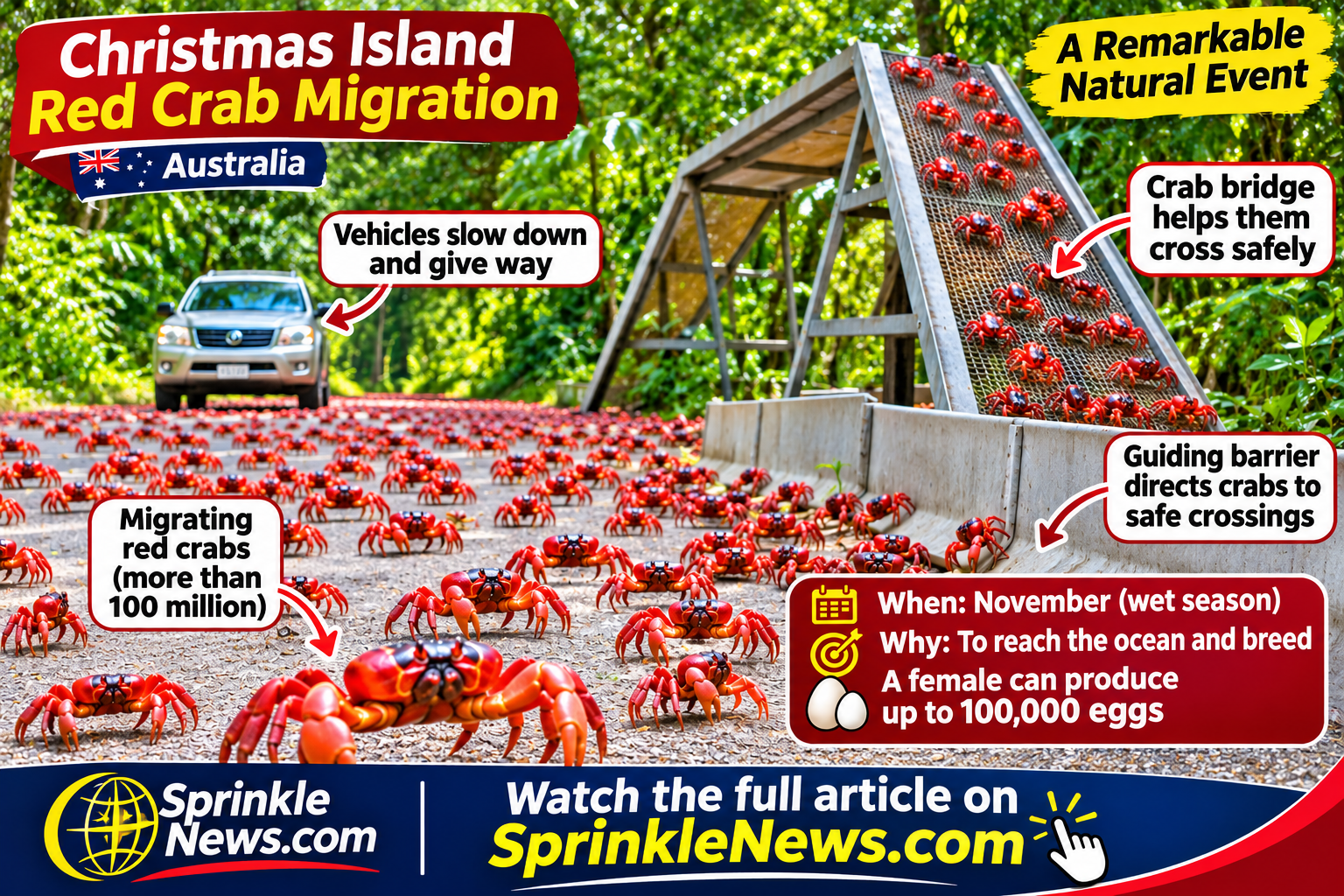
More than 100 million red crabs have begun their annual journey from the island’s forests towards the ocean, turning roads and pathways into remarkable moving carpets of red.
The migration, which takes place during the rainy season, is considered one of the world’s most spectacular natural wildlife events.
And although the sight may appear alarming to someone witnessing it for the first time, residents understand that these unusual visitors are simply following one of nature’s most extraordinary reproductive cycles.
When Crabs Take Priority Over Cars
In most places, roads are built for vehicles and pedestrians. On Christmas Island, however, there comes a time each year when the crabs take priority.
During the migration, authorities temporarily close certain roads to protect the animals as they travel towards the coast.
Drivers who would normally move freely around the island must change their routes, reduce their speed or postpone journeys.
For some residents, an ordinary trip to work or a nearby beach becomes an exercise in patience.
According to ABC News Australia, residents sometimes use garden rakes to help clear paths for the crabs and reduce the risk of crushing them under vehicle tyres.
Others limit unnecessary driving during the busiest migration periods.
It is an extraordinary arrangement in which an entire community adjusts its daily activities to accommodate millions of tiny travellers.
Special Bridges Built Just for Crabs
One of the most fascinating aspects of the migration is the infrastructure designed to keep the animals safe.
Christmas Island has specially constructed crab bridges that allow the creatures to cross above busy roads rather than walking directly into traffic.
Roadside barriers help guide them towards safer crossing points.
During the migration, thousands of crabs can be seen climbing these structures as they continue their journey towards the sea.
The bridges have become attractions in their own right, with visitors gathering to watch the unusual sight.
For many people, the idea of building bridges specifically for crabs may seem surprising.
However, the structures demonstrate how conservation measures can help protect wildlife while allowing people to continue living and working in the same environment.
Why Are Millions of Crabs Moving at the Same Time?
The migration is connected to the beginning of the wet season.
For most of the year, Christmas Island’s red crabs live in the forest, sheltering in burrows and feeding on fallen leaves, fruits and other organic material.
When the first significant rainfall arrives, the damp conditions provide a suitable opportunity for them to begin their journey.
The crabs emerge from their forest homes and move towards the coastline to breed.
What makes this migration especially remarkable is the coordination involved.
Although the crabs begin travelling in response to rainfall, the timing of their breeding is also closely linked to the phases of the moon and the ocean’s tides.
The females release their eggs into the sea around the last quarter of the moon, when the tide is receding before dawn.
Scientists are still investigating how the animals navigate so effectively and coordinate their movements.
The ability of millions of creatures to undertake this journey without human guidance remains one of the most fascinating aspects of the phenomenon.
The Males Arrive First
The journey does not end when the crabs reach the beach.
Male crabs generally lead the migration and arrive at the coast before many of the females.
After reaching the sea, they replenish moisture before moving to nearby areas to dig breeding burrows.
With enormous numbers of crabs competing for suitable locations, finding a burrow can become a challenge.
The females eventually arrive, and mating takes place in or near the burrows.
After mating, the males begin returning towards the forest, while the females remain closer to the coast as their eggs develop.
This stage of the breeding cycle can take approximately two weeks.
One Female Can Produce Up to 100,000 Eggs
Perhaps one of the most astonishing facts about Christmas Island’s red crabs is their reproductive capacity.
According to Parks Australia, a single female can produce up to 100,000 eggs.
The eggs are carried in a special pouch beneath her body while they develop.
When conditions are suitable, the female moves towards the shoreline and releases her eggs into the ocean.
Millions of tiny larvae can then enter the surrounding waters.
However, producing enormous numbers of eggs does not guarantee that all the young crabs will survive.
Many become food for fish and other marine animals.
Only a relatively small proportion survive the early stages of life and eventually return to land.
The Incredible Return of the Baby Crabs
The adult migration is only one part of this extraordinary natural event.
After the eggs hatch, the larvae spend several weeks developing in the ocean.
Those that survive eventually transform into tiny young crabs and begin moving back towards the island’s forests.
These miniature crabs may measure only around five millimetres across.
Despite their small size, they undertake a difficult journey inland, crossing beaches and rocky terrain in search of shelter.
Parks Australia estimates that the young crabs can take approximately nine days to reach the island’s higher forest areas.
They then spend their early years hidden among rocks and vegetation.
The return of the baby crabs can create another extraordinary sight when large numbers survive and emerge from the sea.
In some years, very few young crabs survive. In other years, successful breeding produces enormous numbers, helping maintain the population over time.
A Tourist Attraction Unlike Any Other
While some destinations attract visitors with beaches, shopping centres or historic buildings, Christmas Island offers something entirely different.
Its annual red crab migration has become one of the island’s most famous natural attractions.
Wildlife enthusiasts, researchers, photographers and tourists travel to the territory hoping to witness the spectacle.
During peak periods, the crabs can cover forest paths, coastal areas and roads in remarkable numbers.
Some visitors watch from designated viewing points, while others carefully observe the animals moving through the surrounding landscape.
Popular places for viewing include Flying Fish Cove, Ethel Beach, Greta Beach and Drumsite.
Visitors are advised to follow local guidance, respect road closures and avoid harming or disturbing the animals.
For those fortunate enough to witness the migration, the experience can provide unforgettable photographs and memories.
Millions of Crabs, but Why Are They So Important?
The red crabs are not simply an unusual tourist attraction.
They play a vital role in maintaining Christmas Island’s forest ecosystem.
By feeding on fallen leaves and other organic material, the crabs help recycle nutrients into the soil.
Their burrowing and feeding activities influence the forest floor and affect how plants grow.
Conservationists describe them as a keystone species, meaning their activities have an unusually important influence on the wider environment.
Without a healthy red crab population, the balance of the island’s forest ecosystem could change significantly.
This is one reason why protecting the animals has become such an important priority.
The Hidden Threat Facing the Red Crabs
Despite their enormous numbers, Christmas Island’s red crabs face serious environmental threats.
One of the most damaging has been the invasive yellow crazy ant.
These ants can form large colonies and attack red crabs using formic acid.
Over time, their spread has contributed to the deaths of millions of crabs and disrupted parts of the island’s natural ecosystem.
Conservation programmes have therefore focused on controlling the invasive ants and protecting native wildlife.
According to reports published in November 2026, these efforts have contributed to a significant recovery in the red crab population.
Conservationists estimate that numbers have increased from approximately 50 million to more than 100 million.
This recovery illustrates the importance of sustained environmental protection and scientific management.
Scientists Are Still Trying to Solve the Mystery
Although the migration has been studied for years, researchers still have unanswered questions.
One particularly interesting mystery is how the crabs know which direction to travel.
Researchers from Lund University in Sweden have been investigating whether the animals use environmental signals, such as sunlight, the Earth’s magnetic field or patterns of light, to navigate.
Scientists are also interested in whether younger crabs learn anything about migration routes from older individuals.
Understanding these behaviours could provide further insights into how animals navigate long distances.
The unanswered questions make the migration not only a tourist attraction but also an important subject for scientific research.
People Around the World Can Watch the Migration Live
Technology has made the 2026 migration particularly accessible.
Christmas Island National Park has introduced livestreams allowing viewers in other countries to follow the movement of the crabs.
This means that people who cannot travel to the island can still experience parts of the spectacle from their homes.
The broadcasts show the creatures moving across specially designed crossing structures and other parts of their migration route.
For schools, families and wildlife enthusiasts, the livestreams offer an opportunity to learn about animal behaviour and environmental conservation.
The initiative also helps raise international awareness of the importance of protecting wildlife habitats.
Could You Imagine Living Among Millions of Crabs?
For people living elsewhere in the world, sharing roads and neighbourhoods with millions of migrating crabs might seem almost impossible.
Imagine leaving your home for work and having to stop because thousands of crabs are crossing the road.
Or planning a weekend outing only to discover that your usual route has been temporarily closed for wildlife.
Yet for Christmas Island residents, these adjustments are part of an annual natural event.
Rather than attempting to prevent the migration, communities and conservation authorities have developed ways to accommodate it.
Their approach demonstrates that people and wildlife can share the same environment when appropriate measures are taken.
A Remarkable Reminder of the Wonders of Nature
The red crab migration provides a fascinating example of the complexity of the natural world.
Millions of creatures respond to changes in rainfall, travel towards the ocean, coordinate their breeding with the lunar cycle and eventually return to the forests.
Their journey involves enormous challenges, from avoiding traffic to surviving natural predators.
Yet the cycle continues year after year.
For some people, the sight of millions of red crabs moving together may be surprising. For others, it is one of nature’s most beautiful and unforgettable displays.
As the 2026 migration continues, Christmas Island has once again attracted attention from around the world.
And while people may sometimes complain about traffic jams caused by cars, residents of this remarkable island have a different kind of traffic to consider.
FINAL REFLECTION AND QUESTIONS
What fascinates me most about this story is how an entire community adapts to the natural movement of millions of animals.
Roads close.
People change their journeys.
Special bridges help the crabs cross safely.
And for a few weeks, these small creatures become the centre of attention.
Before discovering this story, I had no idea that something so extraordinary happened on Christmas Island.
It reminds me that there are countless fascinating stories taking place around the world that many of us have never heard about.
Now I have a question for you.
If millions of crabs suddenly appeared on the roads in your town or village, what do you think would happen?
Would people stop to watch them, rush to catch them, or try to protect them?
And would you be comfortable walking along a road covered with thousands of crabs?
I would really love to hear your thoughts.
Please share your experience in the comments.
On Christmas Island, even the smallest travelers can bring an entire road to a standstill.


