

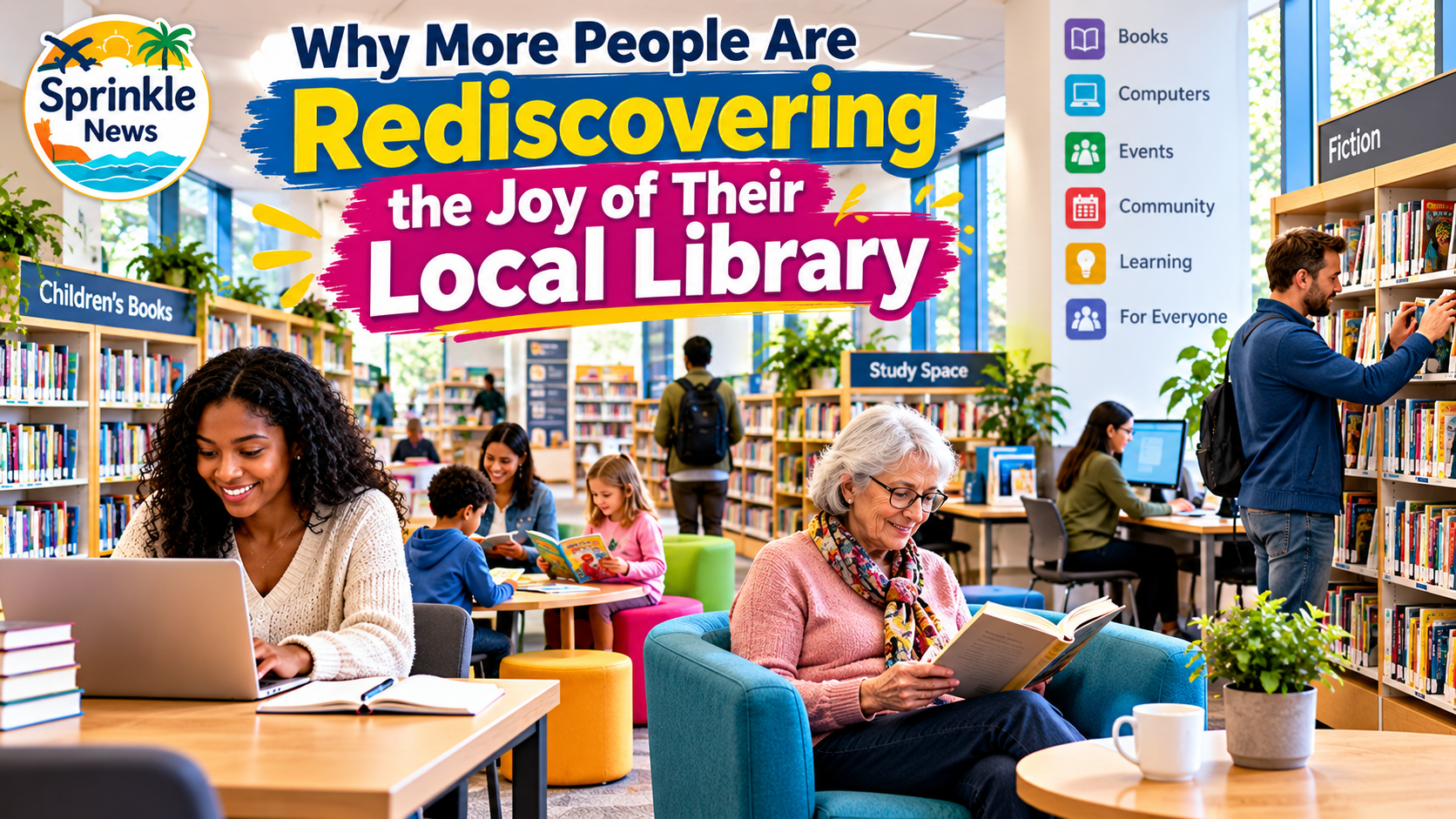
Rediscovering The Joy of The Local Library
For many people, the word library brings back memories of childhood: shelves filled with books, a librarian behind a desk and reminders to keep quiet.
But walk into many libraries today and you may discover something quite different.
There are still books, of course, but there may also be computers, study areas, children’s activities, community groups, digital services and people simply looking for a comfortable place to spend an hour.
At a time when so much of everyday life has moved online, the local library remains one of the few public places where people can walk through the door without being expected to buy something.
Perhaps that is one reason it still matters.
More Than a Building Full of Books
The traditional purpose of a library has not disappeared. People still visit to borrow novels, biographies, cookbooks, travel guides and children’s stories.
But libraries have gradually become much more than places to borrow books.
Someone may visit because they need a computer. Another person may need somewhere quiet to complete an application or study for an examination. A parent may bring a young child to a reading session, while an older visitor might simply enjoy browsing the newspapers or spending time around other people.
Different generations can use the same building for completely different reasons.
That flexibility is one of the library’s greatest strengths.
A Place Where You Don’t Have to Buy Anything
Think about how many places we visit where spending money is part of the experience.
We enter a café and order something. We visit a shopping centre surrounded by things to buy. Even many leisure activities require tickets, subscriptions or membership fees.
A public library feels different.
You can walk inside, browse a shelf, sit down and read without needing to make a purchase.
That may sound like a small thing, but it is increasingly unusual.
For someone trying to reduce spending, a library can provide hours of entertainment and learning without another online order appearing on the bank statement.
Instead of buying every book that catches your attention, you can borrow one, enjoy it and return it for someone else.
There is something refreshingly simple about that arrangement.
Libraries Still Matter in a Digital World
It might seem strange that libraries remain useful when information is available almost instantly through smartphones.
Yet having enormous amounts of information available does not mean everyone has equal access to it.
Not everybody has a suitable computer at home. Internet access can be unreliable or expensive. Some people find completing important forms on a small phone screen difficult.
Libraries can help fill that gap.
Access to computers and internet services can be particularly valuable when someone is searching for employment, preparing a CV, completing an application or trying to access an online public service.
The digital age has not necessarily made libraries unnecessary.
In some ways, it has simply given them another job.
A Quiet Place Has Become Surprisingly Valuable
Modern life can be noisy.
Phones ring. Notifications arrive. Televisions play in the background. Family members have different schedules, and people working or studying from home may struggle to find uninterrupted space.
That makes a quiet desk surprisingly valuable.
Students have long used libraries for study, but they are not the only ones who benefit. Someone taking an online course may need somewhere to concentrate. A jobseeker might need an hour to prepare an application. A freelance worker may occasionally want a change from working at home.
Libraries provide something difficult to measure: space to think.
You do not necessarily notice how valuable quietness is until you need it.
Children Can Discover Books Away From Screens
Libraries can also introduce children to reading in a very different way from tablets and phones.
A child can wander between shelves, pick up a colourful book, change their mind, choose another one and discover a story simply because the cover caught their attention.
There is no algorithm deciding what appears next.
That freedom to explore can make reading feel like an adventure rather than an assignment.
Story sessions and children’s activities can also help make books social. Reading does not always have to mean sitting alone. A story shared with other children can become part of a happy day out.
For families watching their budgets, borrowing children’s books also means young readers can enjoy a changing collection without parents having to continually purchase new titles.
Libraries Can Reduce Isolation
One of the less obvious benefits of a local library is human contact.
Not everyone who walks into a library is there because they desperately need a particular book.
For somebody living alone, a short conversation with a member of staff may be one of several important interactions during the day. Community activities can introduce people who might otherwise never meet.
This does not mean libraries can solve loneliness by themselves.
But welcoming public spaces can make communities feel less disconnected.
Sometimes being around other people—even without having a long conversation—can make a day feel different.
Librarians Still Have Something Search Engines Don’t
The internet can produce millions of results in seconds.
The difficulty is often deciding which result is actually useful.
This is where knowledgeable library staff continue to have a role. A librarian may help someone locate a particular subject, identify an appropriate resource or understand where to begin searching.
Technology is extremely useful, but sometimes a person saying, “Try looking here,” can save a great deal of time.
Libraries combine both worlds: access to digital information and access to human guidance.
A Second Life for Books
Libraries are also an interesting example of reuse.
One book can pass through many hands.
Instead of dozens of people each purchasing a copy that may be read once and then left on a shelf, the same library book can be borrowed repeatedly.
Some libraries also sell withdrawn or donated books at low prices, giving readers an opportunity to build their own collections affordably while older books continue to be used.
In an age when we frequently discuss waste and consumption, the library model feels remarkably modern despite being centuries old.
The Pleasure of Browsing
Online shopping is efficient because we can search for exactly what we want.
But efficiency can remove something enjoyable: accidental discovery.
In a library, you might go looking for one book and leave with three completely different ones.
Perhaps a title catches your eye. Maybe a book is displayed on a table. You could find an author you have never heard of or become interested in a subject you had never planned to explore.
There is no guarantee that every book will become a favourite.
That is part of the pleasure.
Borrowing makes curiosity inexpensive.
Libraries Preserve Local Stories
Many libraries also help preserve the history of their communities.
Old photographs, newspapers, maps, archives and local-history collections can tell stories that may be difficult to find elsewhere.
For someone researching their family history, an old street or the development of their town, these collections can be fascinating.
A library therefore does more than provide today’s information.
It can help a community remember yesterday.
A Place for Different Generations
Few public spaces comfortably accommodate a toddler, teenager, university student, parent and pensioner at the same time.
Libraries often do.
Each person may be doing something completely different, but they share the same space.
That mixture is important because communities are made up of people at different stages of life. Places that allow those generations to exist alongside one another help create a sense of belonging.
A children’s reading corner and a local-history section may seem unrelated, but together they represent something powerful: one generation discovering stories while another preserves them.
Perhaps We Never Really Outgrew the Library
Technology has transformed the way we find information, communicate and entertain ourselves.
Yet some simple needs have remained remarkably constant.
People still need places to learn.
Children still need stories.
Students still need somewhere to concentrate.
Jobseekers still need access to information.
Communities still need places where people can meet without being required to spend money.
And sometimes we simply want to pick up a good book and disappear into another world for a while.
The local library may look different from the one many of us remember from childhood, but perhaps that is exactly why it has survived.
It has adapted.
So if you have not visited your local library for years, it might be worth walking through the door again.
You may go in expecting shelves of books.
You might come out having rediscovered something much bigger: a free public space built around knowledge, curiosity and community.


