

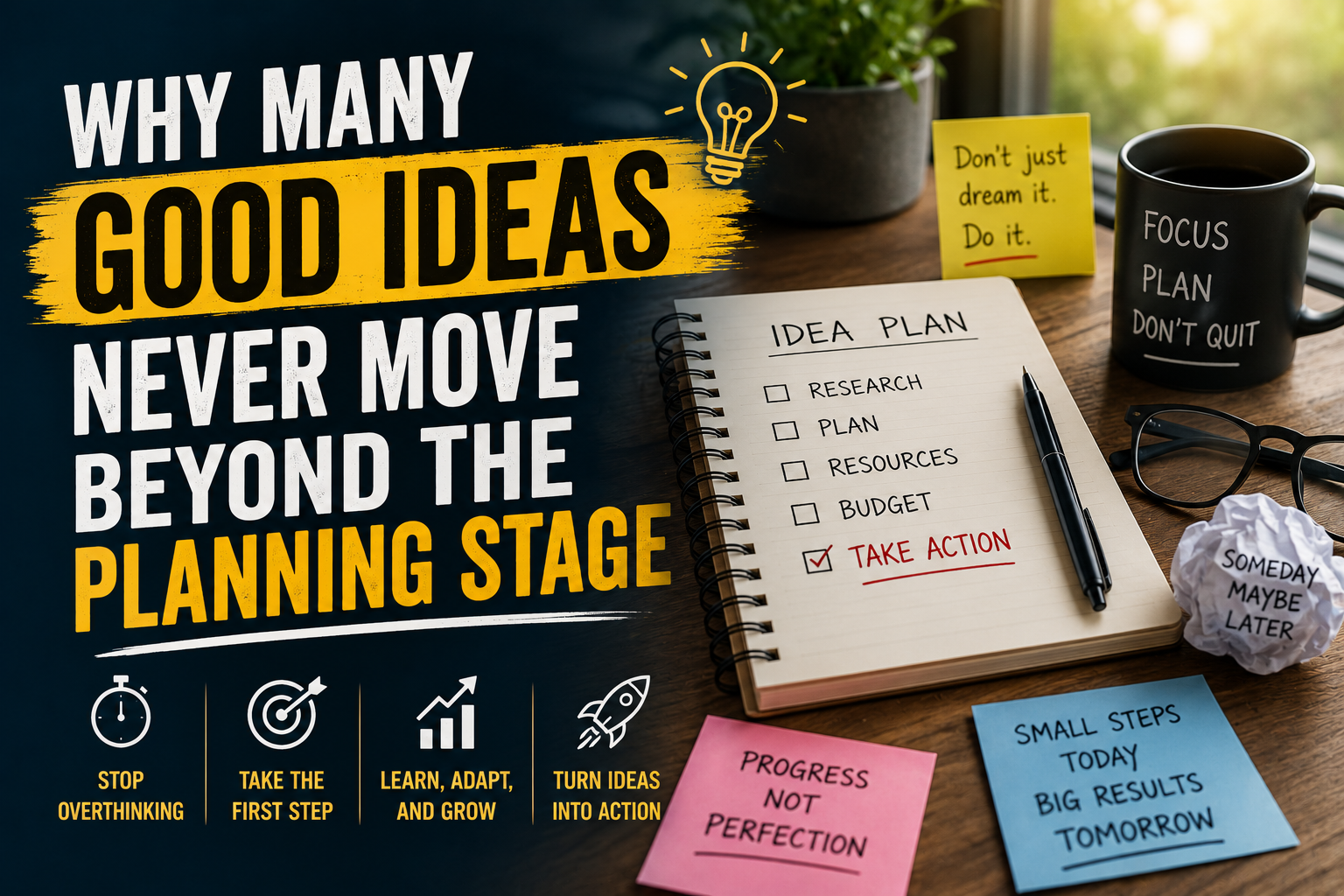
Many Good Ideas Never Move Beyond the Planning Stage
Almost everyone has had an idea that seemed promising.
It may have been an idea for a business, a community project, a book, a new product or a personal goal. At first, the idea creates excitement. Notes are written, plans are discussed and possibilities begin to appear.
Then nothing happens.
Weeks become months, and the idea remains inside a notebook, on a phone or in someone’s mind. This does not always happen because the idea was bad. Many useful ideas never begin because planning feels safer than taking the first real step.
Waiting for the Perfect Moment
One reason people delay acting on an idea is that they are waiting for the perfect time.
They may tell themselves they will begin when they have more money, more knowledge, more confidence or fewer responsibilities. These concerns may be genuine, but the perfect moment rarely arrives.
Life continues to produce new demands. There will always be another bill, responsibility or uncertainty.
Successful projects do not usually begin under perfect conditions. They often begin when someone decides to work with the resources currently available.
This does not mean acting carelessly. Preparation matters. However, there is a difference between responsible preparation and endless delay.
Fear of Failure
An idea feels safe while it remains private. Nobody can reject it, criticise it or prove that it may not work.
Once the idea becomes public, the person behind it becomes vulnerable.
A new business may attract few customers. A book may receive little attention. A community event may have low attendance. These possibilities can feel embarrassing, especially when friends and relatives know about the plan.
Fear of failure can therefore make planning more attractive than action.
However, failure is not always a final result. Sometimes it provides information. A poorly attended event may reveal that the date was unsuitable. A product with low sales may need better packaging or a different audience.
Taking action produces evidence. Remaining in the planning stage produces only assumptions.
Trying to Begin Too Big
Some ideas become difficult because people imagine the finished version instead of the first version.
Someone who wants to start a food business may immediately think about renting a large shop, hiring staff and purchasing expensive equipment. A person who wants to write may imagine completing an entire book before sharing a single page.
The size of the imagined project can become overwhelming.
A smaller beginning may be more practical. The food business could begin with a limited menu and pre-orders. The writer could publish one article. A community organiser could test an idea with a small group before planning a major event.
Starting small does not mean thinking small. It means creating an opportunity to learn without carrying unnecessary risk.
Too Much Advice From Too Many People
Advice can be helpful, but too much of it can create confusion.
One person may say the idea is excellent. Another may say the market is already crowded. Someone else may suggest changing the name, audience, price or entire purpose.
When every opinion is treated equally, the original idea can lose direction.
Not everyone giving advice understands the project or the people it is intended to serve. Some people respond from their own fears and experiences rather than the realities of the idea.
It is important to listen carefully, especially to people with relevant knowledge. However, the person responsible for the project must eventually make a decision.
An idea cannot move forward when every new opinion sends it in a different direction.
The Belief That Everything Must Be Known First
People sometimes delay because they believe they need complete knowledge before beginning.
They may spend months watching videos, reading articles, attending seminars and collecting information. Learning is valuable, but it can also become a hiding place.
Many skills are developed through practice.
A new business owner learns from speaking with customers. A writer improves by writing regularly. A public speaker becomes more confident by speaking in front of people.
Research can prepare someone for the journey, but it cannot replace the journey itself.
There will always be something that was not anticipated. The ability to respond and adapt is often more useful than trying to predict every possibility.
Lack of a Clear First Step
Some ideas remain unfinished because they are too broad.
“Start a business” is not a clear action. “Write a book” is not a task that can be completed in one afternoon.
Large ideas need to be divided into manageable steps.
The first action might be choosing the main product, interviewing five potential customers, writing an outline or identifying a suitable location.
A clear first step reduces anxiety because it gives the person something specific to do. Once that step is completed, the next one becomes easier to see.
Progress often begins when a large dream is converted into a small action.
Comparing the Beginning With Someone Else’s Success
Social media allows people to see businesses, creators and organisations that appear highly successful. What is less visible is how they began.
A new entrepreneur may compare a small project with a company that has been operating for ten years. A beginner may compare an early attempt with the polished work of an experienced professional.
This comparison can create the belief that the new idea is not good enough.
Every established project once had an early stage. It may have had fewer customers, less attractive presentation and many mistakes.
The goal at the beginning should not be to look fully established. It should be to create something useful that can improve over time.
When Planning Is Necessary
Not every delay is caused by fear. Some ideas require careful preparation.
Projects involving large financial commitments, public safety, legal responsibilities or other people’s wellbeing should not be rushed. Research, budgeting and professional advice may be essential.
The important question is whether planning is producing progress.
Useful planning leads to decisions, deadlines and action. Unproductive planning repeats the same discussions without moving the idea forward.
A plan should be a bridge to action, not a permanent destination.
Learning From a Small Experiment
Before making a major commitment, people can test an idea on a smaller scale.
A person considering an online shop can begin with a few products. Someone planning a training programme can hold one workshop. A writer can publish a short article before developing a larger publication.
A small experiment can answer important questions:
Are people interested?
What do they like?
What needs improvement?
How much time and money does the idea require?
Real feedback is often more valuable than months of guessing.
Conclusion
Many good ideas disappear quietly, not because they lacked value, but because the first step was never taken.
Fear, perfectionism, comparison and confusion can make planning feel productive even when no real progress is being made.
An idea does not need to begin perfectly. It needs a reasonable starting point, a willingness to learn and the courage to be seen trying.
The first version may be small and imperfect, but it creates something that planning alone cannot provide: movement.


