

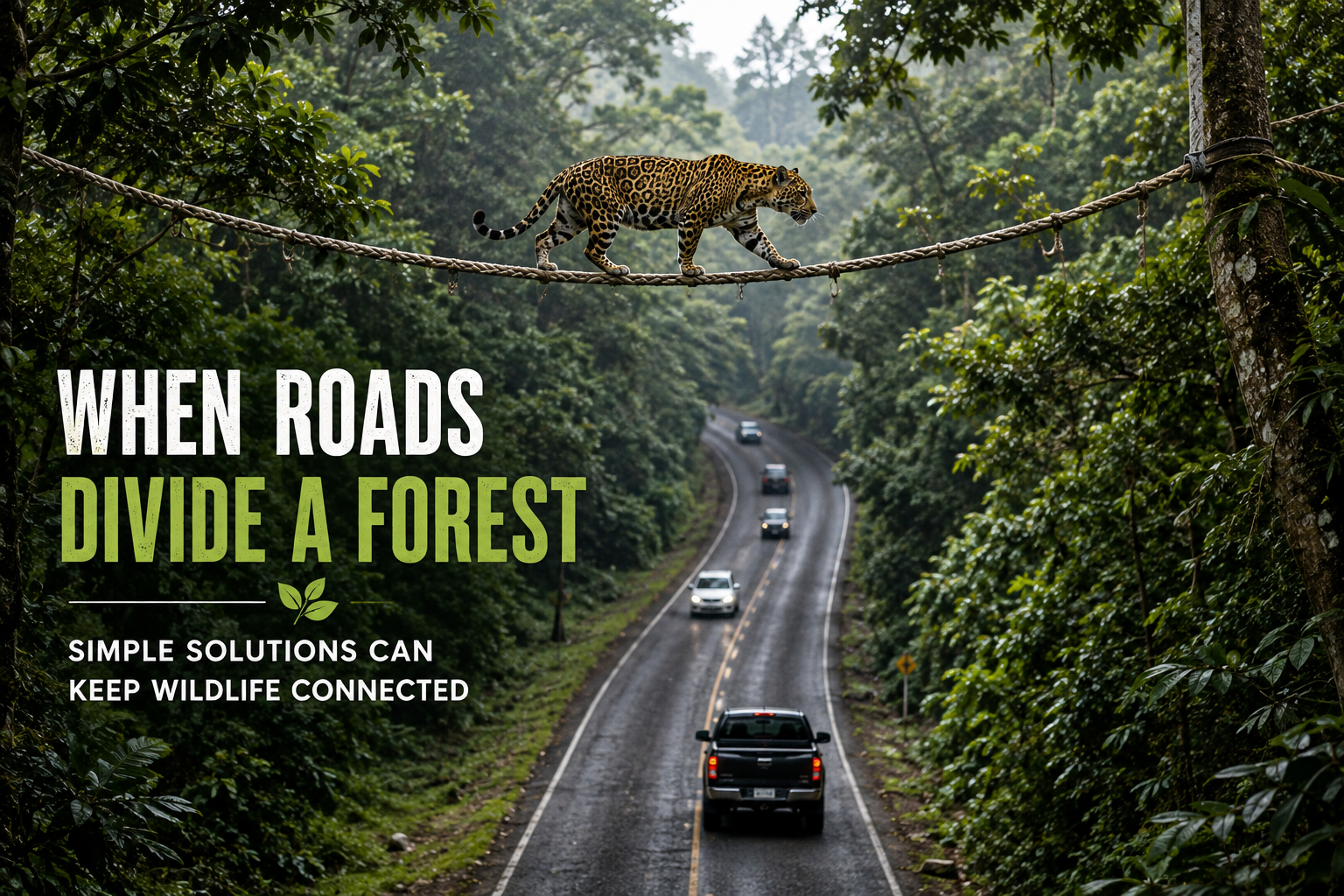
When Roads Divide a Forest, a Simple Rope Can Reconnect It
A road makes travelling easier for people.
For an animal living in the trees, however, that same road can turn one home into two separate worlds.
This is one of the challenges facing wildlife in Costa Rica, where roads, buildings and power infrastructure increasingly intersect with natural habitats.
One surprisingly simple response has been appearing above the ground: canopy bridges connecting trees across dangerous gaps.
They may look like ordinary ropes or suspended pathways.
To wildlife, they can become something much more important — a way home.
What Happens When the Trees Suddenly Stop?
Imagine an animal moving naturally through a forest canopy.
Branch after branch provides a continuous route.
Then the trees disappear.
Below is a road filled with vehicles, buildings or other human activity.
The animal now has a choice it never needed to make when the forest was continuous: turn around or descend to the ground.
For slow-moving animals such as sloths, travelling on the ground can make them especially vulnerable.
Monkeys and other tree-dwelling species face different dangers, including traffic and electrical infrastructure.
Habitat may still exist on both sides of the road, but without a safe connection between them, the animals’ world has effectively been divided.
Building a Road in the Sky
Wildlife canopy bridges attempt to reconnect those separated spaces.
Researchers working on Costa Rica’s Osa Peninsula have used cameras to study how animals respond to different bridge designs.
The idea is wonderfully straightforward.
If human development removes an animal’s natural route, create another one.
No enormous structure is necessarily required.
Sometimes the solution is suspended between two trees.
Small Ideas Deserve Attention Too
When environmental innovation is discussed, attention naturally turns towards major projects: renewable energy plants, electric transport, advanced recycling systems and new technologies.
All of these matter.
But environmental problems exist at different scales, which means solutions should too.
A relatively inexpensive intervention that prevents animals from entering a dangerous road can have value even if it never becomes a billion-dollar technology.
There is something refreshing about that.
Innovation does not always mean inventing something the world has never seen.
Sometimes it means looking carefully at a problem and asking:
What is the simplest thing we could change?
Development Does Not Have to Ignore Wildlife
Human development will continue.
People need homes, roads, electricity, businesses and transport.
The more useful question may therefore be how those things can be designed without unnecessarily destroying the movement patterns of the animals already living there.
Wildlife crossings offer one possibility.
Trees and connected green spaces offer another.
Safer electrical infrastructure can also make a difference.
None provides a complete solution alone.
Together, however, they represent a different way of thinking about development — one in which nature is considered during planning rather than remembered only after wildlife begins disappearing.
Sometimes a Bridge Really Is Just a Bridge
We often use the word bridge as a metaphor for bringing people or ideas together.
In Costa Rica’s forests, the meaning can be much more literal.
There is a tree on one side.
Another tree on the other.
And between them is a gap created by people.
Put back the connection, and an animal can continue its journey.
Sometimes environmental progress begins with something that simple.
Source acknowledgement: Background information was checked against recent reporting and research on wildlife canopy crossings in Costa Rica.
SprinkleNews.com


