

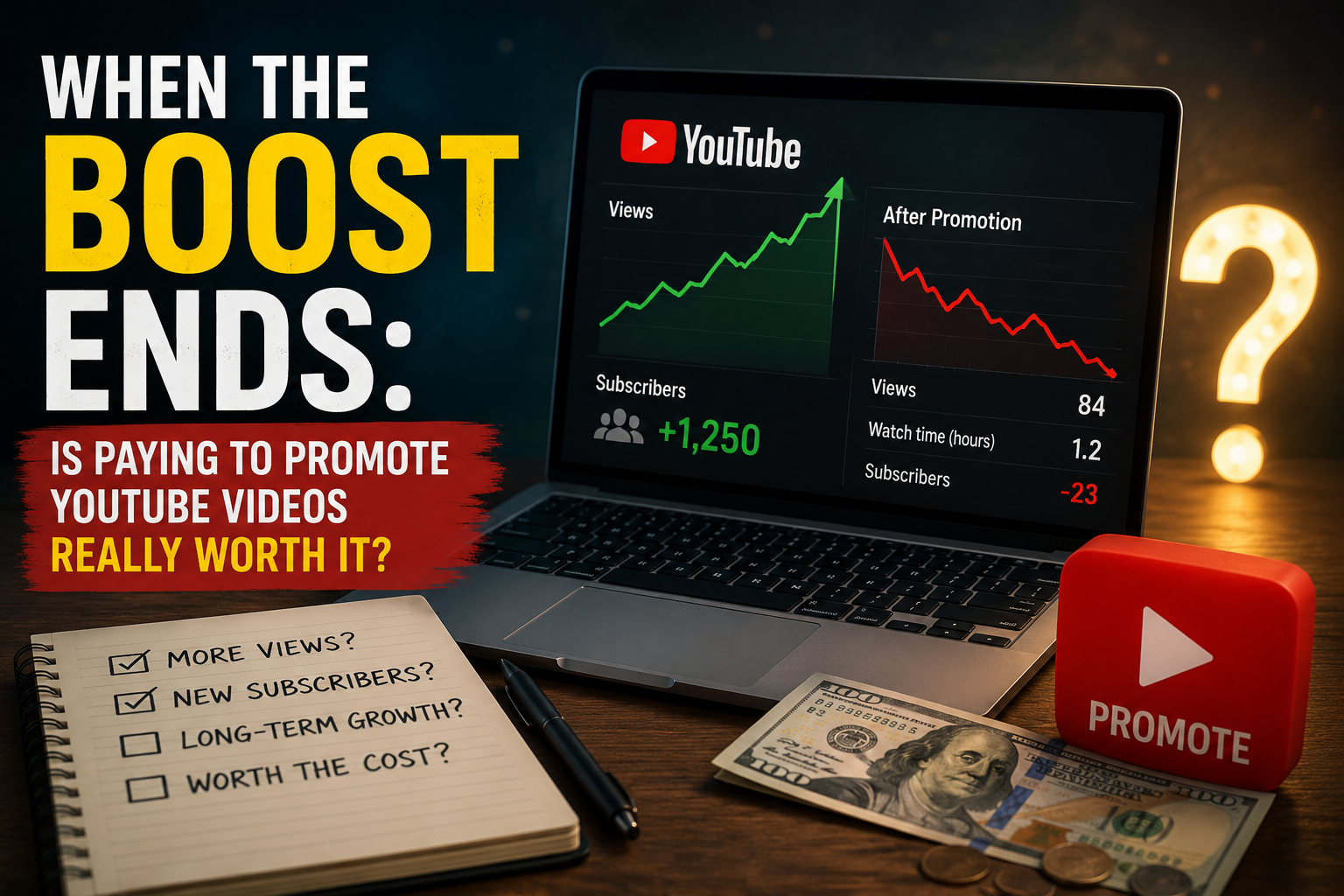
When the Boost Ends: Is Paying to Promote YouTube Videos Really Worth It?
For a new YouTube creator, the temptation to promote a video can be difficult to resist.
A channel may be growing slowly. A video that took hours to create receives only a handful of views. Then a promotion is launched and suddenly the numbers begin moving. Views increase. Subscribers arrive. The channel appears to be gaining momentum.
But what happens when the advertising stops?
That may be the more important question.
Promotion Can Work — But What Does “Work” Mean?
YouTube offers creators its Promote feature to put videos and Shorts in front of new audiences. According to YouTube, views and subscribers gained through these official promotions are legitimate. Promotion can increase visibility, attract subscribers and introduce a channel to people who may otherwise never have discovered it.
So paid promotion itself is not necessarily the problem.
The difficulty comes when creators measure success only by the numbers accumulated during the campaign.
A video may receive hundreds or thousands of promoted views. But once the advertising budget runs out, does the audience continue watching?
Do those new subscribers return for the next upload?
Do they comment, share or explore older videos?
If very little happens afterward, a creator may reasonably wonder whether the campaign built an audience or simply purchased temporary attention.
A Subscriber Is Not Always a Regular Viewer
This distinction is particularly important for small channels.
Someone can watch an advertised video, subscribe and never become a regular viewer. That doesn’t make the subscriber fake. It simply means that subscribing and becoming part of a loyal audience are two different things.
YouTube itself notes that paid traffic can have different audience-retention and click-through rates from organic traffic because promoted content is being presented to new audiences who may engage differently from a creator’s established viewers.
This is why a channel can accumulate an impressive subscriber count while new uploads still struggle to attract viewers.
The subscriber number looks good. The audience behaviour tells another story.
Organic Views Tell Creators Something Different
Organic growth is often painfully slow, but it provides information that advertising can sometimes make harder to see.
Imagine two videos.
One receives 1,000 views after being heavily promoted and almost completely stops when the campaign ends.
Another receives only 50 views initially but continues attracting viewers week after week without advertising.
Which one is performing better?
There isn’t a universal answer. But for a creator trying to understand what people genuinely want to watch, the second video may be providing particularly valuable information.
It is being discovered without somebody paying to put it in front of viewers.
That can help creators identify subjects with lasting appeal.
The Monetisation Catch
There is another reason creators should understand the distinction.
YouTube states that subscribers and watch time gained through advertising campaigns do not count towards YouTube Partner Programme eligibility thresholds.
For full advertising-revenue eligibility, YouTube currently requires 1,000 subscribers together with either 4,000 valid public watch hours from long-form videos in the previous 12 months or 10 million valid public Shorts views in 90 days, along with its other eligibility requirements. Views and watch hours generated through ad campaigns are excluded from the relevant thresholds.
That doesn’t make promotion useless. It simply means creators should know exactly what they are paying for.
Promotion can buy exposure. It cannot buy monetisation eligibility or guarantee a returning audience.
Why Subscriber Numbers Sometimes Go Down
Creators can also become worried when a subscriber count that climbed quickly begins dropping.
A decrease doesn’t automatically mean that anything improper happened.
YouTube says subscriber totals can fluctuate because ordinary viewers unsubscribe, closed accounts are removed, or accounts identified as spam are excluded from the count. YouTube regularly verifies accounts and may correct its metrics accordingly.
Creators can also use YouTube Analytics to examine where subscriptions came from—including subscriptions attributed to YouTube advertising—and where some subscriber reductions originated.
That information can be more useful than watching the headline subscriber number alone.
Perhaps Small Creators Should Test Before They Spend
Paid promotion can still have a place.
It may help introduce a new channel, test a particular video or reach an audience in a particular location. A successful advertisement may even introduce someone who becomes a long-term viewer.
But repeatedly paying to increase every video’s numbers can make it difficult for a small creator to answer a fundamental question:
What would people watch if I stopped paying them to see it?
Sometimes the answer becomes apparent only when the promotion stops.
Certain videos continue receiving views. Others suddenly become quiet. One subject consistently attracts new viewers while another repeatedly struggles.
Those differences are valuable.
They tell the creator what the audience—not the advertising budget—is choosing.
The Bigger Number Isn’t Always the Better Result
For creators building from the beginning, perhaps success should not be measured only by how quickly a channel reaches 500, 1,000 or 10,000 subscribers.
A smaller audience that returns regularly may ultimately be more valuable than a much larger subscriber count that rarely translates into views.
That doesn’t mean creators should never advertise.
It means advertising and audience-building should not be mistaken for the same thing.
Promotion can introduce the channel.
Good content has to give people a reason to return.
And sometimes the videos that quietly continue gaining views long after the advertising has finished may tell a creator far more about the future of the channel than the video with the biggest number on the screen.
Sprinkle News Editorial


