The Sacred Golden Stool: Ghana’s Hidden Soul
Deep in the Ashanti Region of Ghana lies one of Africa’s most revered and mysterious treasures—a sacred object so important that an empire once went to war over it. Known as the Sika Dwa Kofi, or the Golden Stool, it is far more than a symbol of royalty. To the Ashanti people, it represents the very soul of their nation.
Visitors to the historic city of Kumasi may hear stories about the legendary Golden Stool, but few fully understand its significance. Unlike an ordinary throne, the Golden Stool is never sat upon. According to Ashanti tradition, it contains the collective spirit of the Ashanti people—the living, the dead, and those yet to be born.
The origins of the Golden Stool are rooted in one of Ghana’s most famous legends. Oral history tells that in the late seventeenth century, the respected priest Okomfo Anokye called the stool down from the heavens during a gathering of Ashanti chiefs. The stool is said to have descended from the sky and landed gently in the lap of King Osei Tutu, marking the birth and unity of the Ashanti Kingdom.
From that moment, the stool became the most sacred object in the kingdom. It was not considered the property of any king but rather the spiritual embodiment of the entire Ashanti nation. Every ruler who followed was expected to protect and honour it.
Because of its sacred status, the Golden Stool is treated with extraordinary care. It is never allowed to touch the bare ground and is traditionally placed on a special platform or animal skin. No one may sit on it, and it is handled only by trusted custodians during important ceremonies.
For centuries, the stool has been surrounded by secrecy. Its exact location is known only to a select few guardians and royal officials. This mystery has helped preserve both its physical safety and its spiritual significance.
The Golden Stool remains one of the most powerful cultural symbols in Ghana today. It represents unity, identity, resilience, and the enduring traditions of the Ashanti people. Even in the modern era, it continues to command immense respect and serves as a reminder of a rich history that has survived generations of change.
Yet the greatest challenge to the Golden Stool was still to come. At the beginning of the twentieth century, a British colonial governor would make a demand so shocking that it would spark one of the most famous resistance movements in African history.
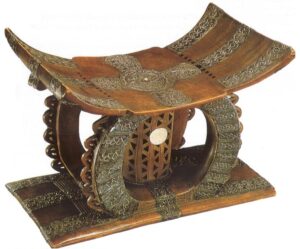
The Golden Stool is traditionally depicted as a wooden stool adorned with gold coverings and ornaments. Its value lies not in the quantity of gold it contains but in its sacred significance as the spiritual symbol of the Ashanti nation.”
Coming Next: Part 2 – The Queen Mother Who Defied an Empire: How Yaa Asantewaa Led the War of the Golden Stool.”