

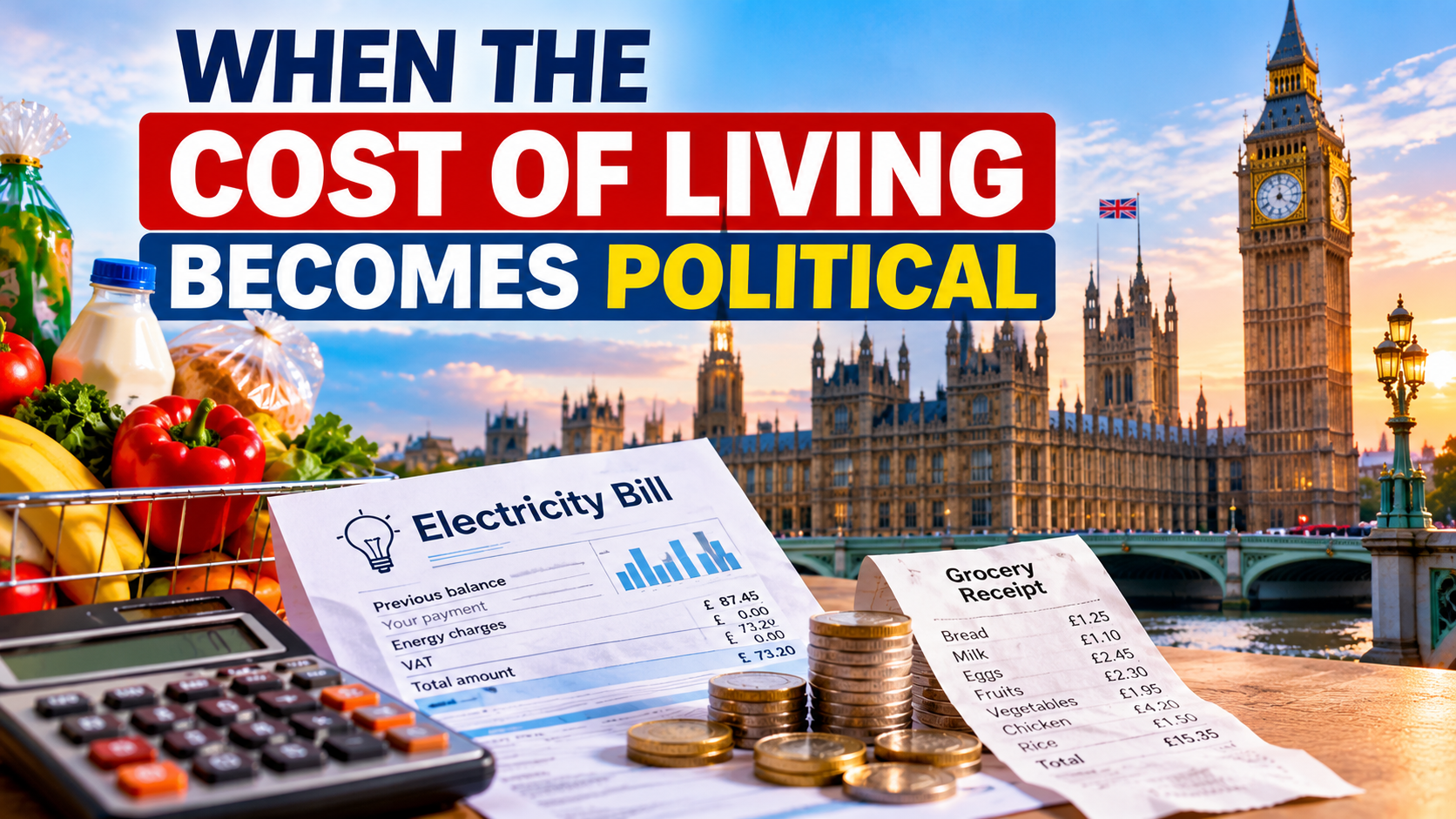
When the Cost of Living Becomes Political: What Families Really Want to Feel in Their Pockets
Politics can sometimes feel far removed from ordinary life. There are speeches in Parliament, announcements from Downing Street and arguments over figures that run into billions of pounds.
But for most households, politics becomes real in much smaller places: the supermarket checkout, the electricity meter, the petrol station and the balance left in the bank account at the end of the month.
That is why the cost of living remains such an important political issue in Britain.
Recent years of higher prices have changed the way many people think about money. Even when inflation falls, families do not automatically feel that everything has become cheap again. A lower inflation rate simply means prices are generally rising more slowly; it does not reverse all the increases households have already experienced.
House of Commons Library research published in September says the period of high inflation between 2021 and 2024 continues to affect household incomes, spending, poverty, savings and debt.
And the longer-term figures help explain why.
Consumer prices were around 30.7% higher in June 2026 than in January 2021, while food prices had risen even more over the same period.
That is a considerable change for a household budget.
A Small Saving Can Still Matter
From 1 October, VAT on domestic electricity in Great Britain was reduced from 5% to zero as part of government measures intended to ease cost-of-living pressures.
The government estimated that the measure would take around £45 from the annual Ofgem price cap.
Forty-five pounds will not transform a family’s finances.
It will not suddenly make the weekly food shop inexpensive, reduce the rent or mortgage, or remove every worry about winter bills.
But that doesn’t necessarily make it meaningless.
For someone with plenty of disposable income, £45 over a year might appear insignificant. For a household carefully watching every pound, small savings across several bills can make a difference.
The bigger political question is whether people begin to experience sustained improvement rather than a collection of temporary reductions.
People Experience the Economy Differently
One difficulty for any government is that national economic statistics and individual experiences don’t always seem to tell the same story.
A politician may point to improving inflation.
An economist may discuss economic growth.
A household may simply reply: My shopping still costs more than it used to.
All three statements can exist at the same time.
People experience the economy through their own circumstances.
A family with several children will notice food prices differently from someone living alone.
A commuter may be particularly concerned about transport and fuel.
A pensioner spending more time at home may pay closer attention to heating and electricity.
A renter facing an increase may barely notice a saving elsewhere because housing consumes so much of the monthly budget.
That is why political arguments about living standards eventually have to move beyond headline figures.
The Supermarket Test
Perhaps one of the simplest tests of economic confidence happens during an ordinary food shop.
Are people choosing what they actually want, or constantly replacing items with cheaper alternatives?
Are they putting something back after seeing the price?
Are families reducing treats that once felt ordinary?
Are people able to save something after paying their essential bills?
These questions may never appear in a government economic statement, but they shape how people judge whether their circumstances are improving.
If wages rise but essential expenses rise just as quickly, the improvement may be difficult to feel.
And when people repeatedly hear that the economy is getting better while their own finances remain tight, a gap can develop between economic statistics and public experience.
Politics Eventually Comes Back to Everyday Life
Governments have to think about national finances, taxation, public services, borrowing and long-term economic growth.
Those are complicated responsibilities, and there are rarely simple solutions.
But voters also judge politics through much more immediate experiences.
Can I afford my energy bill?
How much does my weekly shopping cost?
Can I afford the journey to work?
Can my family occasionally enjoy something without worrying about the money afterwards?
Can I save for an emergency?
Those questions cross political party lines because they are questions about everyday life.
What Would Real Improvement Look Like?
Perhaps the strongest sign of an improving cost of living would not be another government announcement.
It would be when people gradually stop talking about the cost of living quite so much.
When shopping feels less stressful.
When an unexpected bill doesn’t immediately create panic.
When households can save again.
When families have enough room in their budgets for something beyond survival.
Government policies can contribute to that, but public confidence will ultimately depend on what people experience for themselves.
The VAT reduction on electricity may provide some relief this winter, but households will judge the wider political promise on something much bigger.
Not simply what politicians say is happening to the economy.
But what ordinary people can actually feel happening in their pockets.


