The African Queen Who Challenged An Empire (Golden Stool -Part 2)
In the early years of the twentieth century, the Ashanti Kingdom faced one of the greatest threats in its history. British colonial expansion had already weakened the kingdom, and its ruler, Asantehene Prempeh I, had been captured and exiled. The British believed that removing the king would bring the Ashanti people under their control.
They were wrong.
What the colonial authorities failed to understand was that the true heart of the Ashanti Kingdom was not its king but the sacred Golden Stool—the symbol of the nation’s unity, identity, and spiritual strength.
Everything came to a head in March 1900 when the British Governor of the Gold Coast, Sir Frederick Mitchell Hodgson, arrived in Kumasi. During a meeting with Ashanti chiefs, Hodgson made a demand that shocked everyone present.
He insisted that the Golden Stool be brought before him so that he could sit on it as the representative of British authority.
To the Ashanti people, this was far more than a political request. The Golden Stool was sacred. No king sat on it. No chief sat on it. It represented the soul of the Ashanti nation itself. For a foreign colonial governor to demand possession of it was viewed as an insult of the highest order.
The chiefs were stunned. Many feared the consequences of resisting British rule. Their king was already in exile, and British military power seemed overwhelming.
Then one woman changed the course of history.
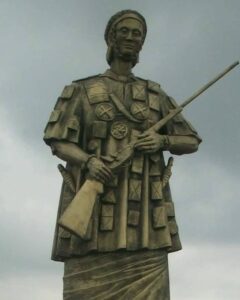
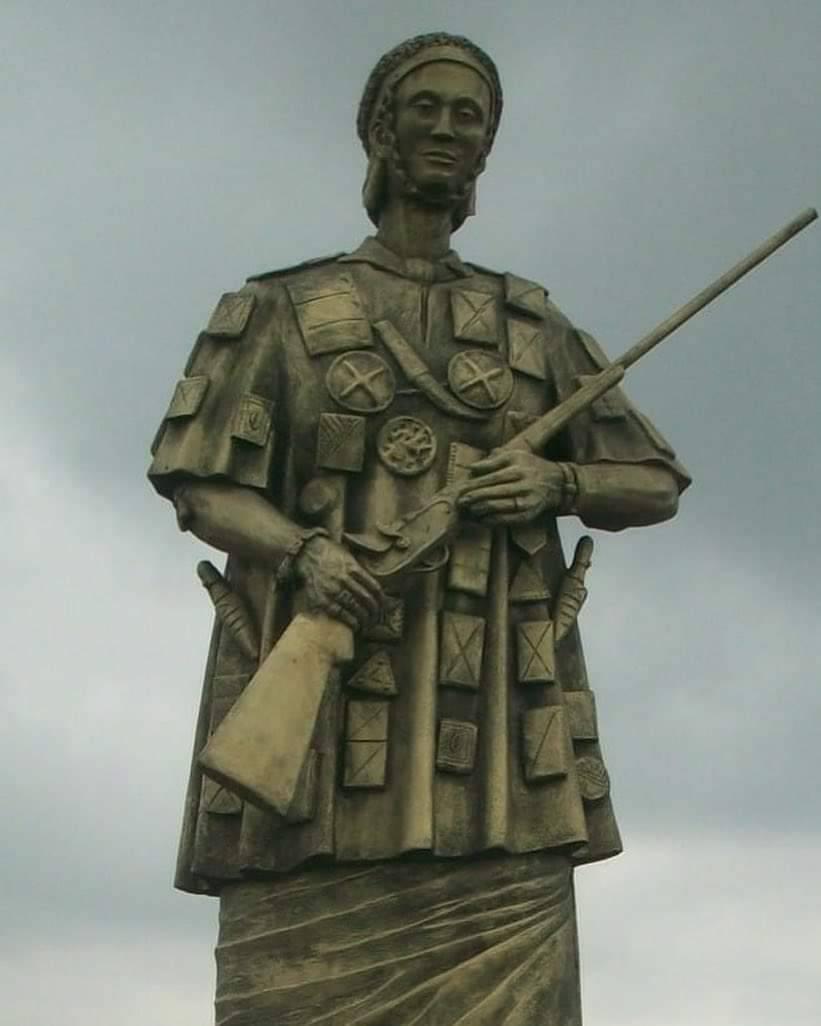
Her name was Yaa Asantewaa, the Queen Mother of Ejisu.
During a gathering of Ashanti leaders, Yaa Asantewaa rose to speak. According to historical accounts, she challenged the chiefs for their hesitation and questioned whether the bravery that had once defined the Ashanti people had disappeared.
She declared that if the men would not fight, then the women would.
Her powerful words inspired the chiefs and warriors to unite once more in defense of their culture, traditions, and sacred symbol.
Soon after, the War of the Golden Stool began.
Under Yaa Asantewaa’s leadership, Ashanti forces launched a determined resistance against British colonial troops. Warriors surrounded British positions in Kumasi and disrupted supply routes through the dense forests of the region.
The conflict was fierce and costly. Both sides suffered significant losses as the fighting continued for months.
Although British reinforcements eventually arrived and suppressed the uprising, the Ashanti achieved something remarkable. Despite all the military power brought against them, the British never obtained the Golden Stool.
The sacred object remained hidden and protected.
Yaa Asantewaa was eventually captured and exiled, joining King Prempeh I far from her homeland. Yet her courage ensured that she would be remembered as one of Africa’s most celebrated resistance leaders.
Today, Yaa Asantewaa is honoured throughout Ghana as a symbol of courage, leadership, and determination. Her stand against colonial rule remains one of the most inspiring stories in African history.
The British may have won the battle, but they failed in their ultimate goal. The Golden Stool remained beyond their reach.
For years afterward, its location remained a closely guarded secret.
But an unexpected discovery decades later would once again place the sacred treasure at the center of a national crisis.
Coming Next: Part 3 – The Secret Discovery: How a Hidden Treasure Nearly Sparked Another Crisis in Ashanti History.