

Beyond the Degree: The Everyday Skills Employers and Young People Are Rediscovering
For generations, education has been closely associated with qualifications. Students study, sit examinations and work towards certificates and degrees that can open doors to further education and employment.
Qualifications remain important. But increasingly, another question is being asked: what can a person actually do with what they have learned?
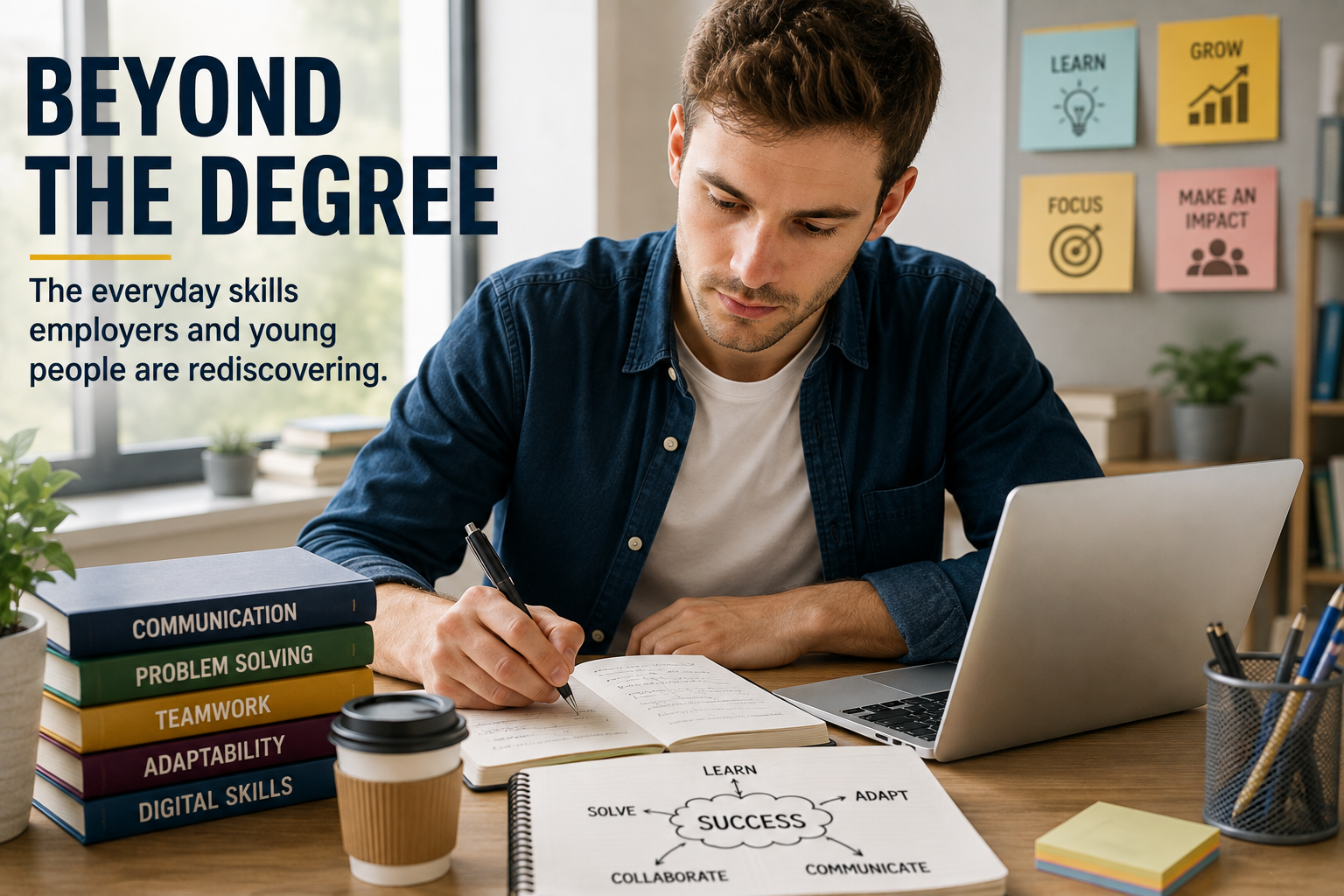
Academic knowledge may help someone secure an interview, but succeeding in the workplace often requires a wider range of abilities. Communication, problem-solving, adaptability, teamwork and digital confidence are becoming just as important in many careers.
Knowing Something and Applying It Are Different
A student may understand a subject extremely well but still find it difficult to explain an idea clearly, organise a project or respond when something unexpected happens.
These abilities are difficult to measure through traditional examinations.
Problem-solving is a good example. At school, questions often have expected answers. In the workplace, the problem itself may not be clear.
An employee might have to deal with an unhappy customer, a delayed delivery, a misunderstanding between colleagues or a project that suddenly changes direction. There may be no textbook explaining exactly what to do.
Being able to assess the situation, ask sensible questions and find a practical solution becomes valuable.
Communication Still Matters
Technology has transformed the way people communicate at work. Emails, messaging platforms and video meetings are now part of everyday working life in many industries.
But having more ways to communicate does not automatically make communication better.
Employees still need to know how to listen, explain ideas clearly and communicate respectfully with different kinds of people.
Even a simple email requires judgement. Should it be formal or informal? How much information is necessary? Could the message be misunderstood?
Good communication is not only about speaking confidently. Knowing when to listen can be equally important.
Adaptability Has Become an Everyday Skill
Many people entering employment today may work in jobs that change significantly during their careers.
New technology can alter familiar tasks. Businesses can enter new markets. Employees may find themselves working with colleagues from different countries or learning new digital systems.
This makes adaptability increasingly valuable.
It does not mean constantly abandoning existing knowledge. Instead, it means being willing to learn, adjust and continue developing.
Someone who can say, “I haven’t done this before, but I can learn,” may sometimes be more useful than someone who refuses to move beyond what they already know.
Practical Experience Builds Confidence
This is one reason internships, volunteering, apprenticeships, project work and part-time employment can be valuable alongside formal education.
They give young people opportunities to practise skills that are difficult to develop from textbooks alone.
Working with others teaches compromise. Meeting deadlines develops organisation. Serving customers builds communication skills. Making mistakes—and learning how to correct them—can build confidence.
Even activities outside employment can develop useful abilities. Organising a community event, participating in a student project or volunteering for a local organisation may involve planning, teamwork and responsibility.
Education and Practical Skills Can Work Together
The discussion should not become a choice between academic education and practical ability.
We need both.
Doctors, engineers, teachers, researchers, accountants and many other professionals require substantial academic knowledge. But they also work with people, solve problems and make decisions.
The strongest preparation for working life may therefore combine knowledge with opportunities to apply it.
Education can teach us what we know.
Experience helps us discover what we can do with what we know.
As workplaces continue to change, that combination may become increasingly important.
A qualification can help open the door, but the ability to communicate, adapt, solve problems and continue learning can help someone move forward once they are inside.


