

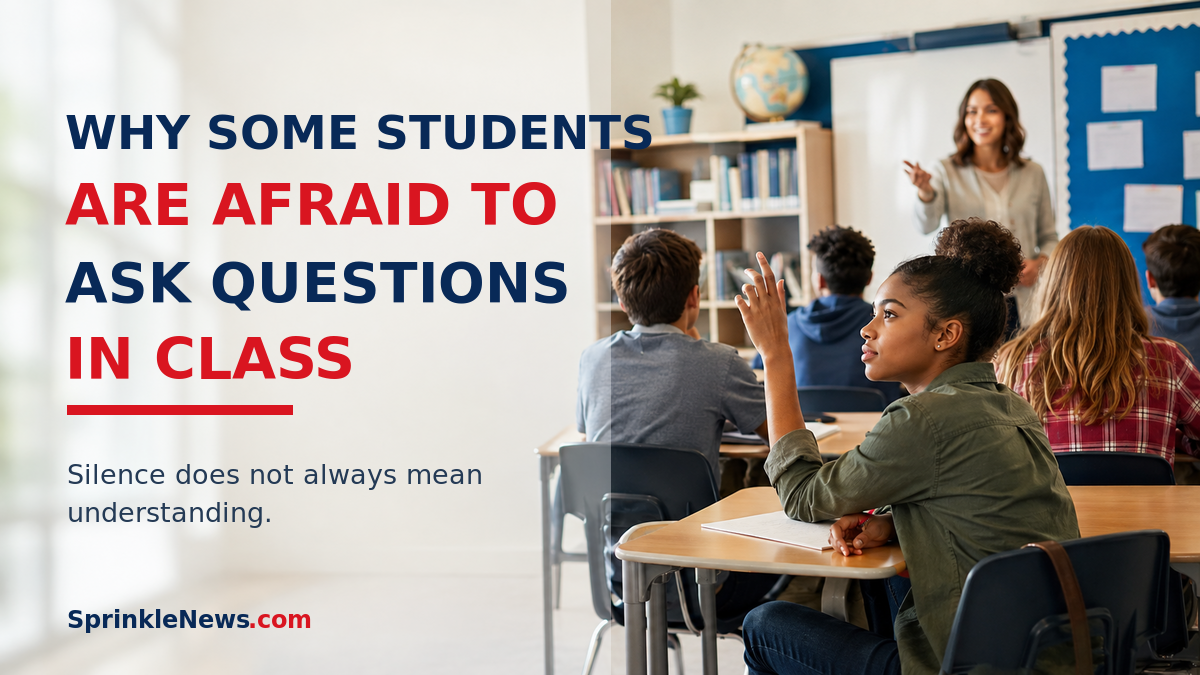
Why Some Students Are Afraid to Ask Questions in Class
A classroom should be a place where students feel free to learn, make mistakes and ask for clarification. Yet many students remain silent even when they do not understand the lesson.
Some are afraid of giving the wrong answer. Others worry that their classmates may laugh at them. A few may believe that asking questions will make the teacher think they are not intelligent.
This fear can quietly affect a student’s confidence and academic progress.
Silence Does Not Always Mean Understanding
Teachers may sometimes assume that students understand because no one is asking questions. However, silence can have many meanings.
A student may be confused but shy. Another may need more time to process the information. Some students may come from educational environments where questioning a teacher is discouraged.
Others may have previously been embarrassed after answering incorrectly and may now avoid participating.
For this reason, classroom silence should not automatically be interpreted as understanding.
The Fear of Being Wrong
Many students learn from an early age that correct answers are rewarded while mistakes are criticised. This can create the impression that being wrong is something shameful.
But mistakes are part of learning. A student who attempts an answer and receives guidance may understand the subject better than someone who remains silent.
When students are afraid of mistakes, they may focus more on protecting themselves from embarrassment than on developing their knowledge.
The Role of Teachers
Teachers can help create an environment where questions are welcomed.
Simple responses such as “That is a useful question” or “Others may be wondering the same thing” can make students feel more comfortable. Teachers can also explain that confusion is normal when learning something new.
Group discussions, anonymous question boxes and short reflection exercises can give quieter students different ways to participate.
Teachers should also avoid mocking incorrect answers or allowing classmates to ridicule one another. A respectful classroom gives students the confidence to take intellectual risks.
The Role of Parents
Parents can also influence how children respond to mistakes.
When a child gives an incorrect answer, the first response should not always be criticism. Parents can ask how the child arrived at the answer and help them understand where the confusion began.
Children who are encouraged to explain their thinking may become more confident learners.
It is also helpful for parents to praise effort, curiosity and improvement rather than focusing only on high marks.
Questions Are Signs of Engagement
Asking a question does not mean a student is unintelligent. It often means the student is thinking carefully and wants to understand more deeply.
Many important discoveries began with simple questions. Progress in science, technology, medicine and society has often depended on people who were willing to ask why something happened and whether there was a better way.
The same attitude should be encouraged in classrooms.
Building Confident Learners
Students need to know that they are not expected to understand everything immediately. Learning is a process, and questions are part of that process.
A classroom where students feel safe to speak can improve confidence, participation and understanding.
The student who asks a question today may help several silent classmates who were afraid to ask the same thing.
Sometimes, one brave question can open the door to learning for an entire class.


