



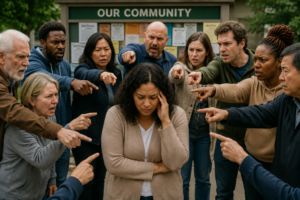

The Blame Game Is Dividing Us
There is something happening in our society that we must talk about honestly.
It is the blame game.
In football, when a team wins, everyone celebrates. Supporters sing, dance, clap, and praise the players. The coach becomes a hero. The team becomes the pride of the people.
But when the same team loses, everything changes.
The players are insulted. The coach is blamed. People forget the training, the pressure, the sacrifices, the injuries, the discipline, and the effort behind the game. One mistake can make people forget many good things.
Many coaches lose their jobs because of defeat. Many players suffer insults on social media because of one bad game, one missed chance, or one mistake. But is this right?
Football is only one example. The same thing is happening in our communities, in politics, and in everyday life.
When there is a flood, people blame the government. When there is a disaster, people blame political parties. When someone tries to help, people still find a way to criticise. When a leader from the ruling party helps, some people politicise it. When a leader from the opposition helps, others politicise it too.
This is getting out of hand.
After floods, families lose homes, properties, clothing, food, documents, and sometimes even loved ones. At that painful moment, what victims need most is support, comfort, food, water, clothing, shelter, and hope.
But instead of focusing on the people who are suffering, many discussions quickly turn into political arguments. People start asking which party is responsible, which leader should be blamed, who donated what, who visited the scene, and who is trying to gain public attention.
But the country belongs to all of us.
Flood victims do not need political arguments. They need help. They need kindness. They need practical support. They need people to stand with them.
When someone tries to help, whether that person belongs to the ruling party, the opposition, a church, a mosque, a company, a community group, a charity, or an ordinary family, we should not turn every act of kindness into politics.
We can question leaders. We can ask for better planning. We can demand proper drainage, safer buildings, better roads, stronger emergency response, and better support for affected people. That is our right.
But we must also be careful not to politicise every incident and every good action.
A leader who helps should not be criticised all the time simply because of political affiliation. A citizen who helps should not be discouraged. A good action should be recognised, even if we do not agree with the person politically.
When we politicise everything, we divide the country.
When we blame all the time, we discourage people from helping.
When we insult instead of suggest, we destroy unity.
When we attack every effort, we make development difficult.
No country develops through blame alone. Development comes when people work together, correct mistakes, support good actions, and find solutions.
The government has a responsibility to help citizens. Leaders must plan, protect lives, provide infrastructure, and respond quickly when disasters happen. But as individuals, we must also ask ourselves: what have we done?
If our neighbour loses property in a flood, do we only complain on social media, or do we help? Do we donate what we can? Do we check on affected families? Do we clear gutters around our homes? Do we stop throwing rubbish into drains? Do we join community clean-up exercises?
It is easy to point fingers. It is harder to lift a hand and help.
There is a saying: the same tongue that enjoys sweet candy is the same tongue that complains about bitter medicine, even when that medicine is needed for healing.
Sometimes the truth is bitter, but we need it.
We cannot keep blaming everyone without offering anything constructive. We cannot keep insulting leaders, players, coaches, and citizens without suggesting solutions. We cannot keep turning every problem into a political fight and expect unity, peace, and development.
Constructive criticism is good. Insult is not.
Constructive criticism says, “This is the problem, and this is how we can improve it.”
Insult says, “You are useless.”
Constructive criticism builds.
Insult destroys.
Constructive criticism brings accountability.
Insult brings division.
Look at social media today. Players are insulted. Coaches are insulted. Leaders are insulted. Ordinary people are insulted. Sometimes people write painful words without thinking about the person reading them.
A footballer who misses a goal is still human.
A goalkeeper who concedes a goal is still human.
A coach who loses a match is still human.
A flood victim who has lost everything should not become a tool for political arguments.
This is not right.
It pains me to write this, but it is the truth.
We must put a stop to this culture of blame, insult, and division.
Let us congratulate people for their efforts, even when the result is not perfect. Let us correct mistakes without destroying people. Let us support victims of disasters instead of using their pain for political arguments. Let us encourage leaders to do better, but also encourage citizens to play their part.
The country is for all of us.
The community is for all of us.
The football team is for all supporters.
Development is for everyone.
When there is a problem, let us talk about the problem. Let us suggest solutions. Let us hold leaders accountable. But let us also ask ourselves what we can do in our own small way.
Blame may give us someone to attack, but it does not always give us a solution.
Insults may make noise, but they do not build a nation.
Politics may win arguments, but kindness wins hearts.
Maybe it is time to stop asking only, “Who is to blame?”
Maybe we should also ask, “How can I help?”
At the end of the day, every society needs accountability, but it also needs kindness.
We can correct without insulting.
We can question without destroying.
We can disagree without dividing.
We can speak the truth without forgetting humanity.
A footballer who misses a goal is still human.
A coach who loses a match is still human.
A leader who makes a mistake is still human.
A flood victim who has lost everything needs help, not political arguments.
Let us stop using every problem as a weapon against one another.
Let us support those who are suffering.
Let us encourage those who are trying.
Let us suggest solutions where we see problems.
Let us build, not only blame.
Maybe it is time to stop asking only, “Who is to blame?”
Maybe we should also ask, “What can I do to help?”
If this message touched you, please like, comment, share, and subscribe. Tell us what you think: do you believe we can correct problems without insults and division?


