

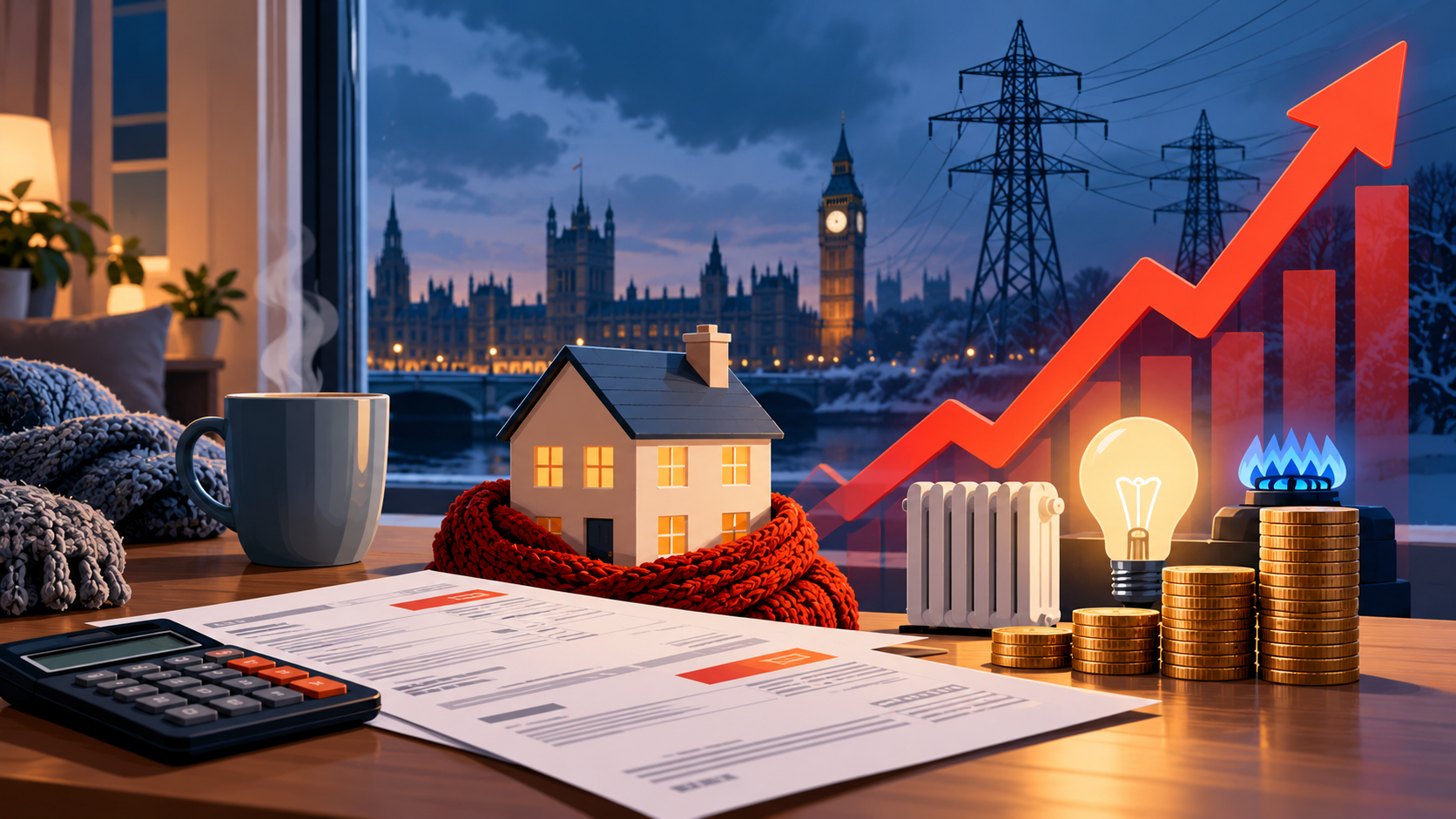
Winter Shock: Household Energy Bills Forecast to Surge 16% in January Over Middle East Tensions
12 October 2026 | Economic | UK News
A stark new financial warning has been issued to millions of families across Great Britain today, with energy experts forecasting a massive double-digit hike to gas and electricity bills early next year. Driven by rising geopolitical instability in the Middle East pushing up global wholesale energy markets, the average household bill is now expected to spiral significantly higher just as the coldest winter months set in.
The latest independent tracking data from leading energy analysts Cornwall Insight reveals that maximum domestic energy rates are on track to jump by 16% in January 2027. This forecasted surge would drive the regular Ofgem price cap up from its current level closer to an annualised £1,999 for a typical dual-fuel household.
The update puts immediate pressure on the British government to expand household relief measures ahead of the highly anticipated Autumn Budget on 28 October 2026. For families balancing tight budgets, it raises an urgent question: should you lock into a fixed energy tariff right now to avoid the winter squeeze?
How International Conflict Hits UK Energy Meters
While the UK does not import the vast majority of its gas directly from the Middle East, our domestic energy supply is bound directly to international markets. When conflict or geopolitical tensions threaten major pipelines or global shipping lanes, international wholesale gas prices spike instantly.
Because gas remains the primary fuel used to generate electricity in Great Britain, a rise in global gas costs triggers an automatic, corresponding surge in domestic electricity rates.
The January price cap update will be calculated using wholesale market data gathered throughout October and November. Because wholesale rates have trended steadily upward over recent weeks, analysts warn that a significant price increase is practically locked into the upcoming regulatory cycle.
The Financial Squeeze Across the West Midlands
The timing of this forecast is particularly brutal for communities across the country. In urban hubs like Birmingham, where a high concentration of older, less insulated pre-war terraced homes exists, energy efficiency remains an ongoing struggle. Local households frequently face disproportionately high heating costs just to maintain basic warmth during the winter drop.
If the annual price cap hits the projected £1,999 mark, an average family will see their monthly energy liabilities jump by roughly £27 per month compared to current autumn rates. While that might sound manageable on paper, it represents a breaking point for low-income households already dealing with prolonged inflation across supermarkets and housing rents.
Furthermore, the rise threatens local independent businesses, from high street cafes to neighborhood workshops, who must absorb these commercial utility increases without driving away their local customer base through higher consumer prices.
Fixed vs. Variable: The Ultimate Winter Dilemma
With a 16% hike looming on the horizon, consumers are facing a critical choice. The standard Ofgem price cap acts as a rolling variable tariff, changing every three months based on market conditions. A fixed tariff, conversely, locks your unit rates in place for a set period—usually 12 months.
Key Factors to Weigh Before Fixing:
-
The 14% Rule: Financial experts generally suggest that if you can find a fixed deal that is less than 14% more expensive than the current October price cap, it is worth considering. It protects you from the massive January spike and provides absolute budgetary certainty.
-
Exit Fees: Always check the fine print for early termination penalties. If global wholesale prices suddenly crash next spring, a high exit fee could trap you on an expensive tariff.
-
Your Personal Usage: If your household consumes a high volume of energy due to a large family or poor home insulation, securing a fixed rate offers significantly higher financial protection than it would for a low-consumption flat.
Step-by-Step: How to Protect Your Budget from the January Price Surge
Do not wait until your January statement arrives to adjust your financial plans. Take these practical actions today to prepare your household.
Step 1: Request a Clean Energy Audit from Your Provider
Log into your online utility account and look over your actual kilowatt-hour (kWh) usage over the past 12 months. This gives you your exact consumption footprint, which is far more accurate than relying on generic national averages.
Step 2: Run a Comprehensive Tariff Comparison
Use official, accredited switching platforms to see what fixed deals are currently open to your postcode. Compare the projected annual cost of those fixed deals against the looming £1,999 January variable forecast rather than comparing them only to your current autumn bill.
Step 3: Maximise Your Direct Debit Discounts
If you currently pay your energy bills via cash, cheque, or quarterly variable invoices, look into switching to a monthly fixed Direct Debit. Energy suppliers offer their lowest unit rates to Direct Debit customers, which can instantly shave up to £100 a year off a typical household bill.
Step 4: Secure Immediate Efficiency Fixes
Conduct a manual check around your home for structural drafts. Simple, low-cost interventions—such as installing adhesive draft-excluding strips around external doors, sealing window gaps, and fitting reflective radiator panels—can lower your total household energy consumption by up to 10% before the winter freeze begins.


