

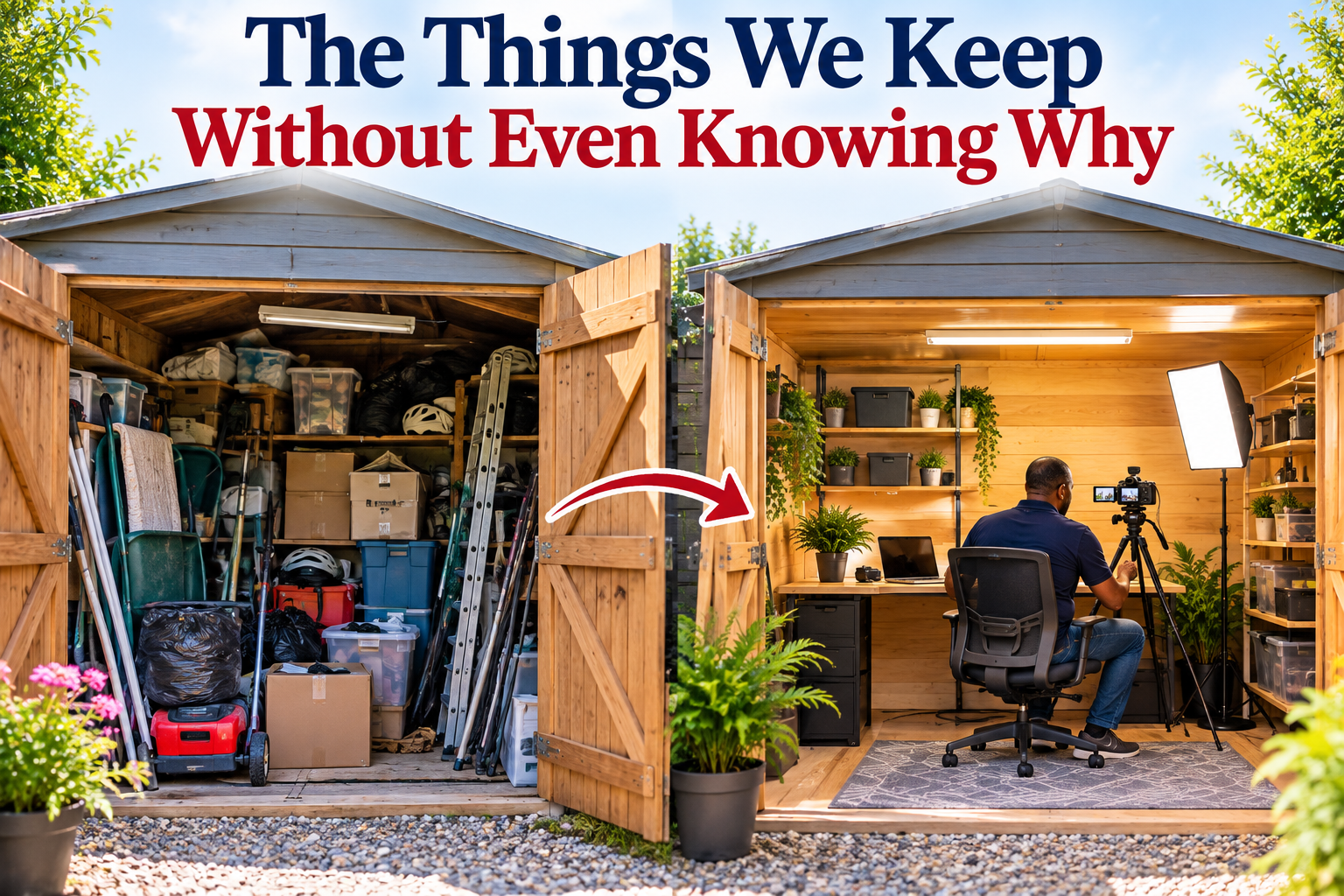
The Things We Keep Without Even Knowing Why
For a long time, our shed was full of things we weren’t really using.
Some of them had probably been put there with good intentions. Something might be useful again. Something might be needed one day. Something seemed too good to throw away.
And then there were probably things nobody had made a decision about at all.
So they stayed.
One item became two. Two became ten. Before long, a space that could have been useful had quietly become somewhere to keep things we rarely thought about.
Recently, I decided to clear some of them out.
What surprised me wasn’t how much we threw away.
It was how much space had been hiding underneath everything we had kept.
Why Do We Keep Things We Don’t Use?
Most of us probably have something like this somewhere.
It might be a shed, a cupboard, a drawer, a spare room, boxes under the bed or bags that haven’t been opened for years.
We know the things are there.
We just stop seeing them.
Sometimes we keep something because it cost money. Throwing it away can feel wasteful even when we haven’t used it for years.
Sometimes there is a memory attached to it.
Sometimes we genuinely believe we’ll need it again.
And sometimes the explanation is much simpler:
We haven’t stopped to ask ourselves why we’re still keeping it.
That was what struck me while clearing our shed.
I wasn’t making difficult decisions about treasured possessions. A lot of what was there was simply taking up space because nobody had made the decision to remove it.
Not Everything Old Is Meaningless
Of course, clearing things out doesn’t mean everything old should disappear.
Some of the least valuable things we own financially can be among the most valuable emotionally.
An old photograph might cost almost nothing, but it can take you back to a moment you had forgotten.
A child’s drawing might be nothing more than paper and crayons to somebody else, but to a parent it can represent an entire stage of childhood.
A ticket from a journey, a letter, an old piece of clothing or a small souvenir can carry memories far beyond its monetary value.
That’s why I don’t think the answer is simply to throw everything away.
Perhaps the better question is:
Does this still mean something to me, or am I keeping it simply because it has always been there?
There is a difference.
The Space Changed Almost Immediately
Once we removed some of the things from our shed, the difference was obvious.
There was room.
Actual usable room.
And then something happened that I hadn’t really thought about when I started clearing.
My husband began using part of the newly available space for making videos.
I found that interesting.
The shed hadn’t become bigger.
We hadn’t extended it.
We hadn’t built another room.
We had simply removed some things we no longer needed, and suddenly the same space had a new purpose.
Something that had been occupied by forgotten belongings was now being used to create something.
That made me look at clearing out differently.
Sometimes Letting Go Creates Something New
We often think about getting rid of possessions as losing something.
But sometimes letting go gives something back.
In our case, it gave us space.
And that space became useful.
It made me wonder how many areas of our homes are currently occupied by things from the past while something we could enjoy today is waiting for room.
It doesn’t necessarily have to become a video space.
An empty corner could become somewhere to read.
A cleared table could become somewhere to work.
A spare room could finally become somewhere guests can comfortably sleep.
Even one empty shelf can make a room feel different.
Sometimes the value isn’t in what you remove.
It’s in what becomes possible afterwards.
But I Still Haven’t Finished
The funny thing is that after seeing the difference, I now want to clear even more.
There are still things that could probably go.
Perhaps that’s another reason we postpone jobs like this. When you look at everything at once, it feels like a huge task.
But you don’t necessarily have to clear an entire shed, garage or room in one day.
Removing some things can already change the space.
And once you see that change, deciding what should stay becomes easier.
The Things We Throw Away Have a Story Too
Clearing the shed also made me think about something I hadn’t considered much before.
We talk a lot about the things we keep.
But what about the things we throw away?
At some point, many of them were important enough for us to buy, carry home and find somewhere to store.
Then slowly, their importance disappeared.
That’s an interesting part of everyday life.
Objects can move from I need this to I might need this to Why am I still keeping this? without us noticing when the change happened.
Perhaps that’s why our homes can become filled with things that belong to an earlier version of our lives.
Keep the Memory, Not Necessarily Everything Attached to It
There are things I would never throw away simply because they hold a memory that matters to me.
But I’ve also realised that keeping a memory doesn’t always require keeping every object connected to it.
We can choose.
Some things deserve their place.
Others have already served their purpose.
And there is nothing wrong with admitting that.
What Is Your Space Waiting For?
Our shed still isn’t empty, and I’m not trying to make it empty.
I simply want the things inside it to deserve the space they occupy.
Seeing my husband using part of the cleared area for his videos has given me another reason to continue.
Because now, when I look at something we haven’t used for years, I don’t only ask:
“Should I throw this away?”
I also ask:
“What could we do with this space instead?”
That question feels completely different.
Sometimes we keep things because they remind us of where we’ve been.
Sometimes we let them go because we’re ready to make room for where we’re going next.


