

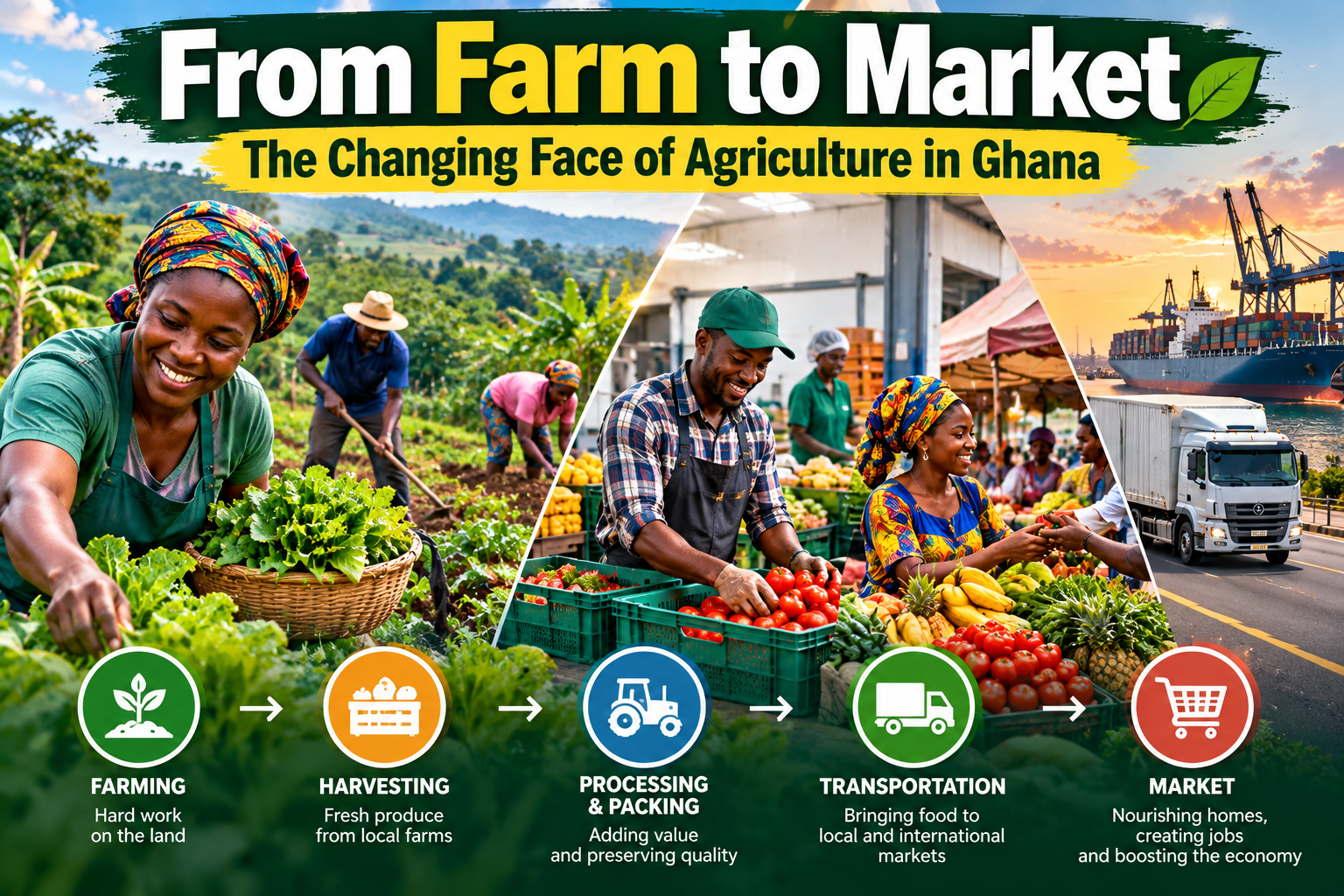
From Farm to Market: The Changing Face of Agriculture in Ghana
Across Ghana, agriculture connects rural communities with busy urban markets, processing businesses and international buyers. Farmers remain at the centre of that system, but the journey from planting to selling is changing.
Technology, processing, transportation, changing consumer expectations and new approaches to farming are gradually reshaping how food moves from Ghanaian soil to the people who eventually consume it.
The Farm Is Only the Beginning
Ghana produces a remarkably diverse range of agricultural products.
Cocoa remains one of the country’s best-known commodities, but Ghanaian agriculture extends far beyond cocoa. Farmers cultivate cassava, maize, yam, plantain, rice, vegetables, fruits and many other crops.
Agriculture also remains an important source of employment. World Bank data show that roughly one-third of Ghana’s employment is connected to agriculture, illustrating how developments in the sector can affect livelihoods far beyond individual farms.
Yet producing food is only the first part of the journey.
Once a crop is harvested, farmers need somewhere to sell it. Produce may have to be sorted, stored, processed, packaged and transported before reaching consumers.
Each stage creates both opportunities and challenges.
A Tomato Has a Journey Too
Consider something as ordinary as a tomato.
After months of preparing land, planting, watering and caring for the crop, harvesting begins. But a successful harvest does not automatically guarantee a successful business.
Fresh tomatoes are highly perishable.
They need to reach buyers quickly and in good condition. Poor roads, transportation delays, inadequate storage or difficulty finding a market can reduce the amount a farmer ultimately earns.
This is where the phrase “farm to market” becomes important.
Agriculture is not simply about how much food can be grown. An effective agricultural system also needs to consider what happens after that food leaves the field.
Reducing What Is Lost Along the Way
Post-harvest losses remain an important challenge across food systems.
When fresh produce is damaged or spoiled between harvesting and consumption, the consequences extend beyond the lost food.
The farmer loses potential income. Traders lose products they could have sold. Consumers lose part of the available food supply. Resources used to grow the crop — including land, labour and water — have also been spent on food that may never be eaten.
Better storage, careful handling, appropriate packaging and more efficient transportation can therefore be just as important as increasing production.
Cold-storage facilities can be particularly useful for certain fruits, vegetables and other perishable products.
But infrastructure alone is not the complete solution. Farmers and traders also need access to information, finance and reliable markets.
Adding Value Before Food Leaves Ghana
There is another opportunity between the farm and the final customer: processing.
Instead of selling every agricultural product in its raw form, processing can transform crops into products with a longer shelf life and potentially greater commercial value.
Cassava can become flour or starch.
Fruits can become juice, dried fruit or other processed foods.
Cocoa can move beyond the export of beans into chocolate and other cocoa-based products.
Tomatoes can be processed into paste and sauces.
This process is commonly described as value addition, and it can create economic activity beyond farming itself.
A stronger agricultural value chain can support jobs in food processing, packaging, quality control, transportation, marketing, logistics and retail.
It means that agriculture can create opportunities for people who may never actually work on a farm.
Technology Is Reaching the Farm
The image of farming as an occupation completely separated from modern technology is also becoming outdated.
Mobile phones already give farmers and traders a simple but powerful tool.
A farmer can communicate with buyers before travelling to a market, check information, arrange transportation and receive or make digital payments.
More sophisticated agricultural technology can go further.
Weather information can help with planning. Digital platforms can connect producers with markets. Irrigation technology can reduce dependence on rainfall, while improved equipment can make certain farming activities faster and less physically demanding.
Not every farmer has equal access to these technologies, however.
Cost, connectivity, training and infrastructure can determine whether a promising innovation actually becomes useful on the ground.
That distinction matters. Technology makes the greatest difference when it solves a problem farmers genuinely experience rather than simply introducing another expensive tool.
Young People Could Change the Image of Agriculture
Ghana also has an opportunity to rethink how farming is presented to younger generations.
Agriculture is sometimes associated primarily with physically demanding work and uncertain income. Those challenges are real, but the sector is considerably broader than traditional farming alone.
Modern agriculture needs entrepreneurs, engineers, food scientists, logistics specialists, marketers, data specialists and business managers.
A young entrepreneur might build a business connecting farmers with restaurants.
Another could specialise in packaging agricultural products.
Someone else might establish a processing company, provide agricultural machinery or develop technology that helps producers find buyers.
Seen from this perspective, agriculture becomes more than growing crops. It becomes an interconnected business ecosystem.
Women Are Central to the Journey
Any discussion of Ghana’s agricultural economy would also be incomplete without recognising women’s contribution.
Women participate throughout food value chains — from farming and processing to transportation, trading and retail.
Visit many Ghanaian markets and their presence is immediately visible.
Market traders perform an important economic function by connecting producers with consumers. They understand prices, customer preferences and supply patterns, and their businesses support households and communities.
Expanding access to finance, equipment, training and markets can therefore strengthen not only individual women-owned businesses but also the wider food system.
Climate Adds Another Challenge
Agriculture has always depended on the environment, but changing weather patterns are making planning increasingly important.
Unpredictable rainfall, extreme heat, flooding and prolonged dry periods can affect crops and farmers’ incomes.
Adaptation can take different forms depending on the crop and location.
Some farmers may need improved irrigation. Others may benefit from different planting schedules, better soil management or crop varieties suited to changing conditions.
There is unlikely to be one solution for every farm.
What works for a cocoa farmer may be completely different from what works for someone producing tomatoes, rice or maize.
The Market Is Changing Too
Consumers are also influencing the agricultural chain.
People increasingly encounter food in many forms: traditional open markets, supermarkets, restaurants, roadside stalls, online sellers and delivery services.
For producers hoping to reach premium or international markets, expectations surrounding quality, traceability, packaging and food safety can be particularly important.
That creates another reason to think about agriculture as a complete chain rather than focusing exclusively on production.
The farmer may begin the process, but processors, transporters, wholesalers, retailers and consumers all influence what happens next.
From Ghanaian Soil to International Shelves
Some Ghanaian agricultural products travel much further.
Cocoa is the obvious example, but Ghana also exports products including fruits and processed agricultural goods.
International markets can create valuable opportunities, but they also bring stricter requirements.
Quality standards, certification, consistency and transportation become increasingly important when food is travelling thousands of kilometres.
For Ghana, increasing the amount of value created before agricultural products leave the country could provide additional economic opportunities.
Instead of viewing agricultural success only in terms of how much raw produce is exported, attention can also be given to how much processing, packaging, branding and employment takes place locally.
More Than a Farming Story
The journey from farm to market tells us something important about the changing face of agriculture in Ghana.
The future of the sector will not depend only on producing more.
It will also depend on how efficiently food is stored, processed, transported and sold — and how much value is created along the way.
That opens the door to a much wider group of people.
Farmers will remain at the heart of agriculture, but the sector also needs entrepreneurs, transporters, processors, researchers, retailers, technology providers and young people willing to see opportunities where previous generations may have seen only difficulties.
The next time fresh produce appears on a market table, it is worth remembering that its journey began long before the customer arrived.
Behind it is a chain of people, businesses and decisions stretching all the way back to the soil.
And strengthening that journey from farm to market could be one of the keys to building a stronger and more resilient agricultural economy in Ghana.


