

When Did We Stop Talking?
How Screens Are Quietly Changing Families, Friendships and Communities
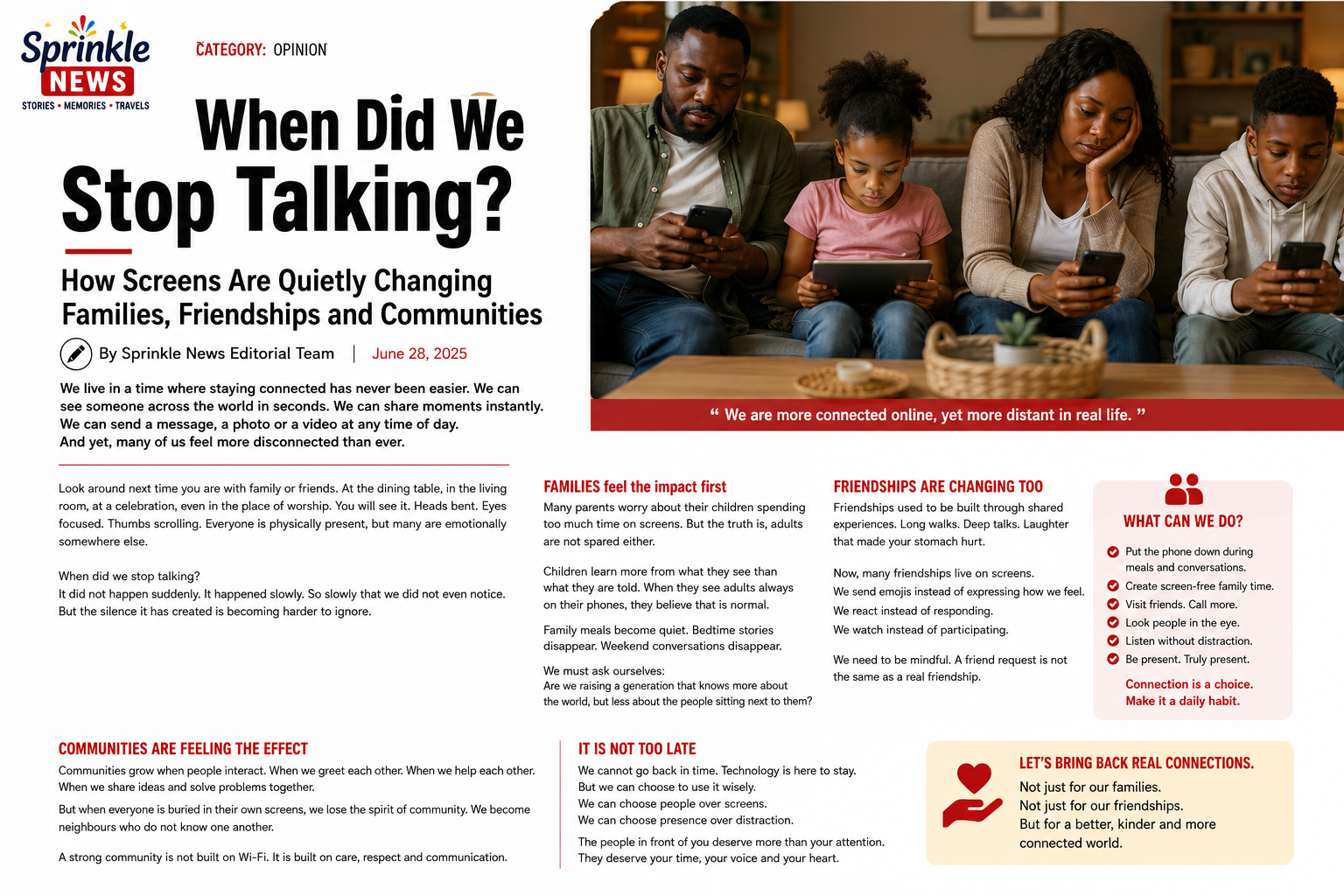
A family sits together in the same room, yet each person is absorbed by a different screen. They are connected to the world, but disconnected from one another.
Introduction
There was a time when the sound of conversation filled our homes.
Children returned from school eager to tell their parents about their day. Families gathered around the dinner table, laughing, debating, telling stories and planning for tomorrow. Neighbours chatted over garden fences. Friends met not because they had arranged it through an app, but because someone simply knocked on the door.
Those moments may not have been perfect, but they were real.
Today, many homes are quieter—not because people have nothing to say, but because their attention is somewhere else.
Walk into a restaurant and you may see a family of four sitting together, yet each person is looking at a different screen.
Visit a park and you might notice parents scrolling through social media while children play nearby.
Ride a train or bus, and almost every passenger is looking down at a phone rather than around at the people beside them.
Technology has transformed our lives in extraordinary ways. We can speak to loved ones on the other side of the world within seconds. We can learn almost anything with a simple search. Businesses, schools and hospitals all depend on digital communication.
None of these achievements should be ignored.
The question is not whether technology is good or bad.
The question is whether we are allowing technology to quietly replace something that has always made us human—conversation.
The Conversation We Didn’t Notice We Were Losing
Most changes in society happen gradually.
Very few people woke up one morning and decided they no longer wanted to talk to their families or friends.
Instead, the change happened little by little.
The phone came to the dinner table.
Notifications interrupted conversations.
Television gave way to tablets.
Tablets gave way to smartphones.
Then came social media, streaming platforms and endless scrolling.
Before long, silence became normal.
Not uncomfortable silence.
Digital silence.
People sitting together without speaking.
Children waiting for eye contact while parents replied to one more message.
Friends meeting for lunch but spending half the meal taking photographs instead of creating memories.
We did not stop talking overnight.
We simply became busier talking to people who were somewhere else.
More Connected Than Ever—Yet More Alone
It is one of the great paradoxes of modern life.
Never before have human beings been able to communicate with so many people so easily.
Yet many surveys around the world suggest that loneliness, social isolation and feelings of disconnection are increasing.
How can both be true?
The answer may lie in the difference between communication and connection.
Sending an emoji is communication.
Clicking “like” is communication.
Watching someone’s holiday online is communication.
But genuine connection often requires something deeper.
It requires listening without interruption.
Looking someone in the eye.
Sharing silence without reaching for a device.
Laughing together.
Comforting someone during difficult moments.
Celebrating life’s successes face to face.
Technology helps us communicate.
Conversation helps us connect.
The two are not always the same.
The Family Dinner Table
Perhaps nowhere has this change become more visible than around the dinner table.
For generations, mealtimes were about far more than food.
They were moments when families checked on one another.
Parents discovered what had happened at school.
Children learned about responsibility, kindness and respect simply by listening to adult conversations.
Grandparents passed down stories that no textbook could teach.
Today, many dining tables are accompanied by glowing screens.
Televisions remain switched on.
Phones vibrate beside plates.
Messages arrive every few minutes.
Sometimes everyone is present physically, but mentally somewhere else.
The meal finishes.
The plates are cleared.
Very little has actually been shared.
Some families have started introducing simple rules.
No phones during meals.
No television during dinner.
One question for every person at the table.
These may seem like small changes.
Yet they often produce surprisingly meaningful conversations.
Children Learn What They See
Parents naturally want the best for their children.
They encourage good manners, kindness and honesty.
But children do not only listen to advice.
They observe behaviour.
If children regularly see adults checking phones during conversations, they begin to assume that divided attention is normal.
If parents answer emails while listening to bedtime stories, children quietly learn that work always comes first.
If every family outing includes more photographs than conversations, children may begin to measure experiences by how they appear online rather than how they feel in real life.
This is not about blame.
Modern life is busy.
Many parents are balancing work, financial pressures and countless responsibilities.
But perhaps one of the greatest gifts adults can offer children today is something surprisingly simple.
Undivided attention.
Five minutes of genuine listening may leave a deeper impression than hours spent in the same room while distracted.
Friendship Has Changed
Friendship has never disappeared.
It has simply changed its shape.
Many friendships now exist almost entirely through messaging apps.
People exchange photographs.
Share memes.
Comment on posts.
Celebrate birthdays online.
These interactions have value.
They help people stay connected across great distances.
Yet something is often missing.
Long conversations.
Unexpected visits.
Shared walks.
Conversations that continue without anyone checking the time.
Many adults remember spending entire afternoons talking with friends without once looking at a screen.
Today’s friendships sometimes struggle to find that same uninterrupted space.
It is not because people care less.
It is because attention has become one of the most valuable—and most interrupted—resources of modern life.
Communities Once Built on Conversation
There was a time when neighbourhoods naturally encouraged conversation.
People knew the names of those living nearby.
They borrowed tools.
Shared meals.
Helped elderly neighbours.
Children played together outdoors until sunset.
Communities were built through repeated small conversations.
A greeting while collecting the post.
A chat while shopping.
A wave across the street.
Today, many communities remain friendly.
But they are often quieter.
People arrive home, close the front door and reconnect with the digital world rather than the neighbourhood around them.
Without realising it, we may know more about the lives of celebrities than the names of the people living next door.
That is not necessarily because communities have become uncaring.
It may simply be because our attention has been redirected.
Are We Listening—or Just Waiting?
Perhaps the greatest casualty of modern communication is listening.
Real listening requires patience.
It requires resisting the temptation to interrupt.
It means putting aside distractions and allowing another person to finish their story.
Today, conversations are increasingly interrupted by notifications, vibrations and screens lighting up.
Even when we hear the words, our attention is often divided.
People notice this.
Children notice it.
Partners notice it.
Friends notice it.
Everyone wants to feel heard.
Everyone wants to know that, for a few moments at least, they matter more than the device in someone else’s hand.
That desire has never changed.
Only our habits have.


